Introduction
Artificial intelligence has transformed how digital marketers, bloggers, and SEO professionals plan, outline, and produce content. While generating raw text is often the first use case that comes to mind, one of the most powerful applications of artificial intelligence lies in organizing information.
For writers engaged in guest blogging, submitting articles that meet strict editorial standards is essential. Publishers look for clean layouts, logical arguments, and engaging flow. Understanding how AI helps improve guest post structure allows content creators to streamline their writing process, organize headings logically, and produce professional articles that resonate with readers and search engines alike.
What Is Guest Post Structure?
Guest post structure refers to the internal organization of an article published on an external website. A solid structure acts as a roadmap for the reader, guiding them from an initial hook down to a clear conclusion.
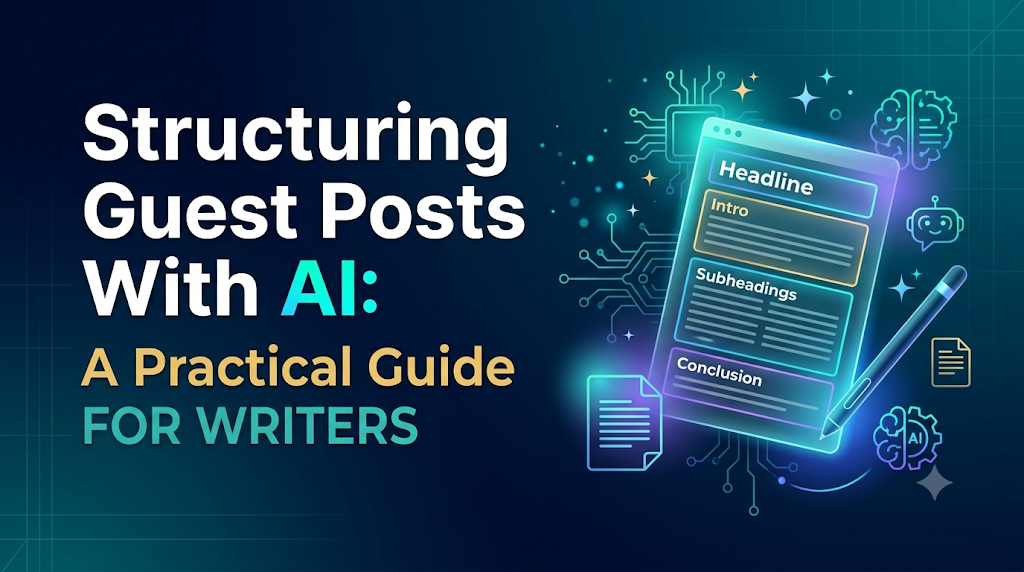
Standard structural components include:
- An Engaging Introduction: Sets expectations, defines the core problem, and introduces the topic.
- Main Body Sections: Divided by H2 and H3 headings to break down complex ideas into manageable parts.
- Supporting Examples: Data points, illustrations, or scenarios that clarify theoretical points.
- Conclusion: Summarizes key takeaways and provides a logical wrap-up.
- Author Information and References: Establishes credibility and attributes credit where due.
Why Guest Post Structure Matters
When a publisher receives a guest contribution, they evaluate it not just for keyword usage, but for overall editorial quality. A poor structure creates friction, causing readers to bounce away quickly.
Proper organization improves readability, ensures comprehensive topic coverage, supports user engagement, and aligns with search intent. When content flows smoothly from one section to the next, both human readers and search engine crawlers can interpret the value of the post much more easily.
How AI Helps Improve Guest Post Structure
Artificial intelligence acts as a digital layout assistant, helping writers bridge the gap between initial brainstorming and a finished draft. Here is how AI tools support the structural phase:
- Topic Analysis and Outline Creation: AI can quickly scan top-performing articles in a niche and suggest comprehensive outline frameworks.
- Logical Sequencing of Ideas: It rearranges raw thoughts into a chronological or thematic sequence that makes sense to readers.
- H2 and H3 Heading Organization: AI suggests descriptive subheadings that break up long text blocks and capture secondary search intent.
- Introduction and Conclusion Planning: It helps draft concise openings that hook readers and conclusions that tie up loose ends.
- Paragraph Length and Readability Improvements: AI flags dense paragraphs and suggests ways to trim or split text for better scannability.
- Identification of Missing Subtopics: By analyzing semantic relationships, AI can highlight angles or questions you might have overlooked.
- Natural Keyword Placement: It suggests where secondary terms fit organically without disrupting the flow.
- Consistent Formatting and Editing: AI ensures uniform tone, capitalization, and structural patterns throughout the draft.
Essential Elements of a Well-Structured Guest Post
To satisfy editors and readers, every guest post should incorporate these core building blocks:
- Relevant and Informative Titles: Clear titles that accurately reflect the article’s core premise without clickbait exaggeration.
- Strong Introductions: Hooks that respect the reader’s time by getting straight to the point.
- Clear Section Headings: Scannable H2 and H3 tags that outline the narrative arc.
- Short, Focused Paragraphs: Keeping paragraphs to three or four sentences prevents visual fatigue.
- Examples and Supporting Evidence: Real-world scenarios that anchor abstract ideas.
- Lists and Tables When Useful: Bullet points and structured tables that make data easy to digest.
- Helpful Conclusions: Summaries that reinforce value rather than repeating the introduction verbatim.
- Accurate Sources and Attribution: Proper context and transparent references for any factual assertions.
AI-Assisted Guest Post Structure vs. Manual Planning
| Feature | AI-Assisted Planning | Manual Planning |
| Planning Speed | Generates outline frameworks in seconds | Requires brainstorming and manual structuring |
| Flexibility | Easily adjusts subheadings based on new prompts | Requires manual rewriting and reorganization |
| Consistency | Maintains uniform heading hierarchy consistently | Susceptible to human fatigue and oversight |
| Editorial Control | Human review required to refine AI suggestions | Full human control from the first sentence |
| Topic Comprehension | Scans broad datasets for related subtopics | Relies entirely on the writer’s existing knowledge |
| Judgment & Nuance | Requires human oversight for emotional resonance | Driven by personal experience and creative intuition |
How AI Improves Readability and Content Flow
Content flow determines whether an article reads like a cohesive story or a disconnected list of facts. AI tools assist by analyzing transitions between sentences and paragraphs.
If a section jumps abruptly from one idea to another, an AI assistant can suggest bridging phrases. Furthermore, AI helps identify redundant explanations, passive voice overload, and overly complex vocabulary, rewriting them into plain, accessible English that matches the target audience’s expectations.
How AI Supports SEO-Friendly Guest Post Outlines
Search engine optimization goes beyond stuffing keywords into a paragraph; it requires satisfying user intent through thorough topic coverage. AI models excel at semantic analysis.
By analyzing top-ranking pages, AI can help you map out related subtopics, questions, and secondary keywords into a logical heading hierarchy. However, writers must remember that structure alone cannot guarantee rankings or backlinks; high-grade original insights, factual accuracy, and editorial rigor remain paramount.
Practical Examples of AI-Assisted Guest Post Planning
1. Structuring an Educational Guest Post for a Technology Blog
- Initial Problem: A draft explaining cloud computing concepts was disorganized, mixing beginner explanations with advanced security protocols without clear separation.
- How AI Helped: The writer fed the raw notes into an AI tool with a prompt to organize the content into logical tiers: basics, benefits, security, and future trends.
- Human Review: The writer added personal case studies and verified that technical terminology matched the host blog’s editorial standards.
2. Organizing a Digital Marketing Article for a Business Audience
- Initial Problem: An article about email marketing strategies lacked clear section headings and contained overly long paragraphs.
- How AI Helped: AI restructured the text into scannable H2 sections focusing on list segmentation, automation, and metric tracking, while shortening bulky paragraphs.
- Human Review: The author reviewed the tone to ensure it sounded professional rather than robotic, adjusting transition sentences for better flow.
3. Improving an Overly Long Draft with Repetitive Headings
- Initial Problem: A draft about remote team management had four separate sections covering communication, leading to repetitive subheadings.
- How AI Helped: AI consolidated the redundant points into a single comprehensive section with distinct H3 subsections.
- Human Review: The editor checked the consolidated text to ensure no unique tips were lost during the trimming process.
Limitations of AI in Guest Post Structure
While artificial intelligence is a useful aid, it is not infallible. Writers should remain aware of potential pitfalls:
- Generic Outlines: AI can sometimes produce predictable, formulaic structures that lack unique angles.
- Factual Errors: AI models may hallucinate information or attribute incorrect concepts to subheadings.
- Repetitive Headings: Unsupervised AI outputs frequently generate repetitive phrasing across sub-sections.
- Intent Mismatches: An AI-generated outline might miss the specific angle requested by a niche publisher.
- Over-Optimization: AI might suggest unnatural keyword stuffing in headings if not prompted carefully.
Human oversight, original research, and careful editing are always required to finalize a high-standard guest post.
How GuestPostAI.com Fits into a Guest Posting Workflow
Managing multiple guest contributions requires organization, clear planning, and efficient content management. Platforms like GuestPostAI.com support outreach and publishing workflows by helping content teams organize their submissions, track publication timelines, and streamline communication with site owners.
Integrating structured writing practices with an organized publishing workflow ensures that every article meets editorial requirements before it goes live.
Step-by-Step Process for Creating a Better Guest Post with AI
- Identify the Target Publication and Audience: Understand who reads the host blog and what topics interest them.
- Review Editorial Guidelines: Check word counts, formatting rules, and link policies.
- Define Purpose and Search Intent: Determine what question the article answers for the reader.
- Research the Topic: Gather accurate data, statistics, and expert insights.
- Generate and Refine Outline: Use AI to build a logical H2/H3 heading framework.
- Check Heading Order: Ensure smooth narrative progression from introduction to conclusion.
- Write Original Insights: Draft the content using personal expertise and unique examples.
- Review Facts and Readability: Check data accuracy, sentence length, and keyword placement.
- Edit for Style: Adapt the tone to match the host publisher’s voice.
- Finalize and Submit: Polish the draft and submit it according to guidelines.
Guest Post Structure Checklist
| Verification Step | Description | Status |
| Clear Title | Accurately describes the topic without clickbait | [ ] |
| Engaging Intro | Hooks the reader and outlines the article’s value | [ ] |
| Logical Headings | Uses H2 and H3 tags to organize subtopics cleanly | [ ] |
| Short Paragraphs | Keeps blocks of text scannable and readable | [ ] |
| Supporting Data | Includes examples, facts, or references where needed | [ ] |
| Natural Keywords | Integrates primary and secondary terms organically | [ ] |
| Strong Conclusion | Summarizes key takeaways and wraps up logically | [ ] |
| Guidelines Met | Complies with the host publisher’s formatting rules | [ ] |
Frequently Asked Questions (FAQs)
1. How does AI improve guest post structure?
AI analyzes top-performing content and helps writers organize ideas, create logical outlines, arrange H2 and H3 headings, and maintain a smooth narrative flow from introduction to conclusion.
2. Can AI create guest post outlines?
Yes. AI tools excel at generating structured outlines based on keywords, topics, or competitor research, helping writers organize their thoughts before drafting.
3. What is the ideal heading hierarchy for a guest post?
A guest post should start with an H1 title, followed by H2 tags for main sections, and H3 tags to break down specific sub-points within those sections.
4. How does AI assist with keyword placement?
AI can review a draft and suggest natural places to integrate secondary and semantic keywords into headings and body paragraphs without disrupting readability.
5. Can AI improve guest post readability?
AI helps improve readability by shortening long paragraphs, flagging complex or passive sentences, and suggesting clearer transition words between sections.
6. What are common AI writing mistakes to avoid?
Common mistakes include accepting generic outlines without customization, leaving repetitive headings unedited, and failing to verify factual claims made by the AI model.
7. Why is human editing still required?
Human editors provide original insights, emotional resonance, fact-checking, and adherence to specific publisher style guides that AI cannot replicate autonomously.
8. Does a good structure guarantee SEO success?
No. While proper structure improves readability and search engine crawling, rankings also depend on content quality, backlink authority, and search intent alignment.
9. How does GuestPostAI.com support guest posting?
GuestPostAI.com helps streamline guest posting workflows, content organization, and publishing coordination for digital marketers and content teams.
10. How long should an AI-assisted guest post be?
Length depends on publisher guidelines, but comprehensive guest posts typically range between 1,500 and 2,500 words to ensure thorough topic coverage.
Conclusion
Structuring a guest post effectively is a balancing act between satisfying editorial guidelines, engaging human readers, and meeting search engine expectations. Artificial intelligence offers valuable assistance throughout this process, from generating initial outline frameworks to refining paragraph flow and organizing heading hierarchies.
However, technology is most effective when paired with human insight, original research, and careful editorial review. By combining AI-assisted organization with your own expertise and a streamlined publishing workflow through platforms like GuestPostAI.com, you can consistently produce high-quality guest posts that drive meaningful results.