Introduction
This guide explains what the Certified MLOps Architect certification represents, who should consider it, and why it has become essential for designing production-ready machine learning platforms. You will learn how this credential moves beyond basic MLOps into system architecture, multi-cloud design, and governance at scale. Professionals in DevOps, platform engineering, cloud architecture, and technical leadership will find practical, experience-based advice to decide if this certification fits their career goals. All official program details are available through the Certified MLOps Architect course page, hosted by aiopsschool which specializes in operational AI and advanced ML infrastructure training.
What is the Certified MLOps Architect?
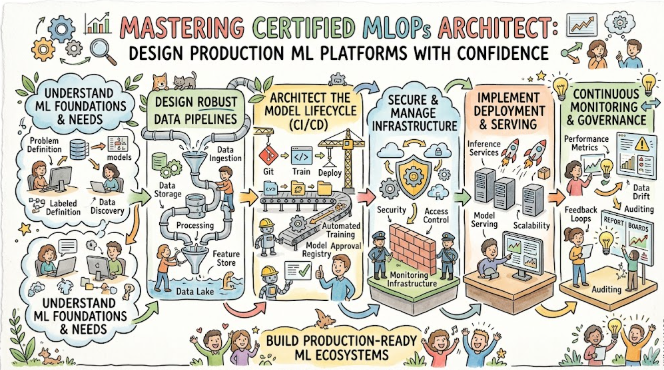
The Certified MLOps Architect certification validates your ability to design end-to-end machine learning platforms that serve hundreds of models across multiple teams and environments. Unlike operational certifications, this credential focuses on architecture decisions: choosing the right orchestration layer, designing feature stores for scale, planning model registry governance, and building for reliability and cost efficiency. It exists because organizations need architects who can translate business requirements into technical blueprints for ML systems that last years, not months. The certification aligns with modern enterprise practices like platform engineering, infrastructure as code, and secure software supply chains for ML artifacts.
Who Should Pursue Certified MLOps Architect?
Senior DevOps engineers transitioning to platform architecture, cloud architects designing AI workloads, and ML engineers who want to lead technical strategy benefit most from this certification. Technical leads, solution architects, and engineering managers responsible for ML platform roadmaps will find the content directly applicable to their daily decisions. Security architects focusing on model governance and FinOps practitioners optimizing ML costs also gain significant value. In the Indian IT services and global product company landscape, this credential distinguishes professionals who can design from those who only implement. Early-career professionals should gain hands-on MLOps experience first, while experienced architects can use this certification to formalize and expand their knowledge.
Why Certified MLOps Architect is Valuable Today and Beyond
Demand for architects who understand ML systems continues to outpace supply as every enterprise builds AI into core products. The certification proves you can make trade-offs between latency, cost, and accuracy at the platform level, not just for single models. Enterprises are retiring ad-hoc ML pipelines and investing in centralized platforms, creating a need for certified architects to lead these transformations. Return on time investment is high because architectural skills remain relevant even as specific tools change every 12-18 months. For professionals in India, where global capability centers and product startups are scaling AI, this credential opens doors to architect-level roles with corresponding salary bands.
Certified MLOps Architect Certification Overview
The program is delivered via the Certified MLOps Architect course on the AIOps School platform. It is a single, comprehensive certification with three distinct levels that build on each other, not separate certificates. Assessment includes scenario-based multiple-choice questions, architecture diagramming tasks, and a final capstone design project reviewed by practitioners. The certification is owned and maintained by AIOps School, known for vendor-neutral, role-based operational technology training. You will be tested on your ability to evaluate trade-offs, justify design decisions, and communicate architecture to both engineers and executives.
Certified MLOps Architect Certification Tracks & Levels
The certification follows a three-level progression that maps directly to career stages in platform architecture. Foundation level covers MLOps architecture components, design patterns, and basic scalability considerations. Professional level adds enterprise topics like multi-tenancy, high availability, disaster recovery, and cost modeling for ML workloads. Advanced level focuses on strategic topics including federated learning infrastructure, LLM serving architecture, regulatory compliance design, and platform evolution roadmaps. These levels are not separate tracks but a recommended sequence for mastering architecture before final certification.
Complete Certified MLOps Architect Certification Table
| Track | Level | Who it’s for | Prerequisites | Skills Covered | Recommended Order |
|---|---|---|---|---|---|
| Platform Architecture | Foundation | Senior ML engineers, DevOps leads moving to architecture | 2+ years MLOps or DevOps, basic cloud knowledge | Architectural patterns, component selection, basic scaling | 1 |
| Platform Architecture | Professional | Platform architects, technical leads | Foundation level, Kubernetes, cloud networking | Multi-tenancy, HA/DR, cost modeling, governance design | 2 |
| Strategic Architecture | Advanced | Distinguished engineers, head of ML platform | Professional level, experience with 3+ production models | LLMOps architecture, compliance automation, platform evolution | 3 |
Detailed Guide for Each Certified MLOps Architect Certification
Certified MLOps Architect – Foundation Level
What it is
This level validates your understanding of MLOps component architecture, including how model registries, feature stores, orchestration engines, and monitoring systems fit together. You will learn to read and critique existing platform designs and propose improvements.
Who should take it
Senior DevOps engineers, ML engineers with production experience, and technical leads who want to move into architecture roles. You should have hands-on experience with at least one MLOps toolchain before attempting this level.
Skills you’ll gain
- Designing a basic MLOps platform architecture for a single team
- Selecting appropriate orchestration tools based on workload patterns
- Planning model versioning and artifact storage strategies
- Creating architecture diagrams that communicate trade-offs to stakeholders
Real-world projects you should be able to do
- Design a platform that serves 10 models with batch and real-time inference
- Create a migration plan from ad-hoc scripts to a registered model pipeline
- Document architectural decisions around feature store vs direct data access
- Present a capacity plan for model training and inference resources
Preparation plan
- 7-14 days: Review MLOps components and common open-source tools. Draw architecture diagrams for sample scenarios from public talks.
- 30 days: Build a small platform on a single cloud using three different orchestration tools. Compare their strengths and weaknesses in writing.
- 60 days: Take an existing production pipeline and redesign it for 10x scale. Document every trade-off. Practice exam scenario questions.
Common mistakes
Designing for perfect technology instead of team skills and budget. Ignoring non-functional requirements like security and compliance early. Choosing tools before understanding integration complexity.
Best next certification after this
- Same-track option: Certified MLOps Architect Professional Level
- Cross-track option: Certified Kubernetes Administrator (CKA) for deeper infrastructure knowledge
- Leadership option: TOGAF 9 or 10 certification for enterprise architecture framework
Certified MLOps Architect – Professional Level
What it is
This level validates your ability to design enterprise-scale ML platforms that serve multiple teams with isolation, shared services, and governance guardrails. You will learn to balance centralization vs autonomy in platform design.
Who should take it
Platform architects, senior technical leads, and engineering managers responsible for ML platform strategy. You should have experience designing systems that serve at least three different product teams.
Skills you’ll gain
- Implementing multi-tenancy patterns for model registries and feature stores
- Designing high availability and disaster recovery for inference endpoints
- Building cost attribution models to show back ML expenses to business units
- Creating compliance automation for model approval, audit, and explainability
Real-world projects you should be able to do
- Design a platform where five teams can deploy models without stepping on each other
- Create a disaster recovery plan with RTO and RPO under 15 minutes for critical models
- Build a cost dashboard that shows training vs inference cost per team per model
- Automate model approval workflows with policy-as-code gates
Preparation plan
- 7-14 days: Study multi-tenant patterns in cloud IAM and Kubernetes namespaces. Research how large enterprises structure ML platforms.
- 30 days: Extend your foundation design to support three teams with quotas, rate limits, and cost tracking. Simulate a tenant outage and practice isolation.
- 60 days: Design a complete enterprise platform with DR, backup, and compliance. Write an architectural decision record for each major choice. Practice the capstone project.
Common mistakes
Over-engineering isolation before understanding actual team needs. Forgetting to design for model deprecation and data retention policies. Assuming all models have same SLAs and cost profiles.
Best next certification after this
- Same-track option: Certified MLOps Architect Advanced Level
- Cross-track option: AWS Certified Solutions Architect – Professional or Azure Solutions Architect Expert
- Leadership option: Certified Agile Leadership (CAL) or team facilitation certifications
Certified MLOps Architect – Advanced Level
What it is
This level validates expertise in strategic ML architecture including LLM serving at scale, federated learning infrastructure, regulatory compliance (GDPR, HIPAA, SOC2), and platform evolution planning over multi-year horizons.
Who should take it
Distinguished engineers, heads of ML platform, and enterprise architects defining AI strategy for entire organizations. You should have experience leading platform migrations and setting technical roadmaps.
Skills you’ll gain
- Designing LLM serving architecture with prompt caching, embedding stores, and cost-aware routing
- Building federated learning infrastructure for privacy-preserving model training
- Implementing automated compliance evidence collection and reporting
- Creating 3-year platform evolution roadmaps with phase gates and deprecation plans
Real-world projects you should be able to do
- Design a platform that serves multiple LLMs with fallback and cost optimization across cloud providers
- Architect a federated learning system for 10,000 edge devices with secure aggregation
- Build an automated audit system that proves model lineage and data provenance
- Create a platform migration plan from legacy ML tools to modern stack with zero downtime
Preparation plan
- 7-14 days: Research LLMOps architecture patterns from published case studies. Experiment with open-source LLM serving stacks locally.
- 30 days: Design a federated learning simulation using mock devices. Implement automated compliance checks using Open Policy Agent.
- 60 days: Build a complete strategic architecture document for a hypothetical enterprise. Defend your trade-offs in a mock review. Complete the final capstone design project.
Common mistakes
Designing for future scale that never materializes, wasting resources. Ignoring organizational change management when introducing new platforms. Choosing bleeding-edge tools that lack enterprise support.
Best next certification after this
- Same-track option: (None – highest level)
- Cross-track option: Certified Information Systems Security Professional (CISSP) for governance deep dive
- Leadership option: Executive MBA or MIT Sloan AI strategy program
Choose Your Learning Path
DevOps Path
DevOps engineers should start with Foundation level to understand how ML architecture differs from traditional application architecture. You will learn to extend your CI/CD knowledge to model versioning, A/B testing infrastructure, and automated rollback strategies for models. The Professional level adds multi-team considerations that prepare you for platform team roles. After certification, you can lead DevOps-to-MLOps transformations inside your organization.
DevSecOps Path
Security engineers and DevSecOps practitioners should take Foundation level to grasp ML-specific risks, then move directly to Advanced level for governance and compliance architecture. You will learn to design secure model supply chains, automate vulnerability scanning for model artifacts, and enforce least-privilege access to inference endpoints. The certification positions you as a security architect for enterprise AI platforms.
SRE Path
Site reliability engineers benefit most from Professional level, which covers high availability, disaster recovery, and error budgeting for model serving. You will learn how to set SLIs for prediction quality, not just latency, and design incident response for model performance degradation. The certification helps you transition from web SRE to ML SRE architect.
AIOps / MLOps Path
This is the direct path: complete Foundation, Professional, and Advanced levels in sequence to become a fully qualified MLOps architect. You will gain the ability to design platforms that serve both traditional ML and LLM workloads. This path is ideal for senior ML engineers moving into platform architecture roles. Completing all three levels makes you a strategic advisor for AI infrastructure decisions.
DataOps Path
Data engineers should take Foundation level to learn how feature stores, data versioning, and pipeline orchestration fit into ML platform architecture. The Professional level adds cost modeling for data pipelines feeding both training and inference. After certification, you can transition into a data platform architect role that supports both analytics and AI.
FinOps Path
FinOps practitioners should focus on Professional and Advanced levels, which include detailed cost architecture for GPU allocation, spot instance strategies, and inference caching. You will learn to design showback and chargeback models that allocate ML costs to business units accurately. The certification allows you to become a FinOps specialist for AI and ML workloads.
Role → Recommended Certified MLOps Architect Certifications
| Role | Recommended Certifications |
|---|---|
| DevOps Engineer | Foundation Level |
| SRE | Professional Level |
| Platform Engineer | Foundation, Professional Levels |
| Cloud Engineer | Foundation Level |
| Security Engineer | Advanced Level |
| Data Engineer | Foundation Level |
| FinOps Practitioner | Professional, Advanced Levels |
| Engineering Manager | Foundation Level (to understand architecture decisions) |
Next Certifications to Take After Certified MLOps Architect
Same Track Progression
After Foundation, move to Professional then Advanced. Each level deepens your architectural thinking from component design to enterprise strategy. You will progress from solving team-scale problems to defining organization-wide ML platform roadmaps over 12-18 months.
Cross-Track Expansion
After Professional level, consider cloud provider architecture certifications (AWS Solutions Architect Professional, Azure Solutions Architect Expert) for depth on vendor-specific services. For governance focus, CISSP or CISM complements Advanced level. These cross-track credentials make you a well-rounded enterprise architect.
Leadership & Management Track
Engineering managers should take Foundation level to understand architectural trade-offs. Then pursue leadership certifications such as Certified Enterprise Architect (CEA) or Stanford AI Executive Program. This combination prepares you to lead ML platform teams and influence C-suite technology decisions.
Training & Certification Support Providers for Certified MLOps Architect
DevOpsSchool
DevOpsSchool offers architecture-focused instructor-led training with case studies from real enterprises. Their curriculum emphasizes architectural decision records, trade-off analysis, and capstone design projects reviewed by industry architects. You get access to recorded sessions and a community of alumni for peer review. Many professionals in India prefer DevOpsSchool for its practical, scenario-based approach to architecture training.
Cotocus
Cotocus provides personalized mentoring for the Certified MLOps Architect exam, including one-on-one sessions with experienced platform architects. They help you map your existing experience to certification requirements and identify skill gaps. Their flexible scheduling works well for senior professionals with demanding day jobs. Cotocus also offers mock architecture reviews that simulate the capstone project evaluation.
Scmgalaxy
Scmgalaxy focuses on the infrastructure foundation required for MLOps architecture, including Kubernetes design, service meshes, and multi-cloud networking. Their workshops prepare you for the cross-track knowledge needed at Professional and Advanced levels. You will learn to design resilient, scalable foundations before adding ML-specific components. Scmgalaxy is ideal for architects coming from traditional DevOps backgrounds.
BestDevOps
BestDevOps delivers accelerated architecture bootcamps that compress the Foundation and Professional levels into four weeks. Their curriculum is updated every quarter to reflect the latest LLMOps and federated learning patterns. You will work on a real-world capstone project that becomes part of your portfolio. BestDevOps is known for high pass rates and strong peer networking.
devsecopsschool
DevSecOpsSchool integrates security architecture into every level of MLOps Architect training. Their courses cover threat modeling for ML systems, secure model supply chains, and compliance automation design. You will learn to architect platforms that pass SOC2 and HIPAA audits out of the box. This provider is essential for security engineers moving into AI platform architecture.
sreschool
SRE School offers architecture training with a reliability lens, covering SLO design, error budgets, and chaos engineering for ML platforms. Their curriculum includes designing for graceful degradation when model serving fails. You will practice running architecture reviews focused on production readiness. SRE School graduates often become ML platform reliability architects.
aiopsschool
AIOps School is the official certification provider and offers the most direct preparation path. Their self-paced course includes video lectures, architecture pattern libraries, and a mock capstone project with feedback. You get lifetime access to materials and updates as the certification evolves. Many learners prefer AIOps School for its authoritative content and direct alignment with exam objectives.
dataopsschool
DataOps School focuses on the data architecture side of MLOps, including feature store design, data mesh for ML, and real-time pipeline architectures. Their training prepares you to design platforms where data engineering and ML engineering collaborate seamlessly. You will work with tools like dbt, Kafka, and Feast at architectural depth. This provider is excellent for data engineers transitioning to platform architecture.
finopsschool
FinOps School offers specialized architecture modules on ML cost optimization, including GPU cluster design, spot bidding strategies, and inference caching architectures. Their training is essential for the Professional and Advanced levels’ cost modeling sections. You will learn to design platforms that provide cost visibility and control by default. FinOps School is unique among MLOps architecture training providers.
Frequently Asked Questions (General )
1. How difficult is the Certified MLOps Architect exam?
The exam is significantly more difficult than operational certifications because it tests judgment and trade-offs, not just tool knowledge. Most experienced professionals need 4-6 months of preparation including the capstone design project. The scenario-based questions and architecture review are the biggest challenges.
2. How many hours should I study per week to pass?
Plan for 10-12 hours per week over 12-16 weeks for Foundation level. Professional and Advanced levels require 12-15 hours per week due to the capstone project. Consistency and practical design practice matter more than total hours.
3. What are the prerequisites for this certification?
You need solid hands-on experience with MLOps tools (MLflow, Kubeflow, or similar) and production model deployments. For Professional and Advanced, you also need experience designing systems for multiple teams or compliance requirements. No formal degree is required, but architecture experience is essential.
4. How long is the certification valid?
The certification does not expire, but AIOps School recommends recertification every three years as architecture patterns evolve. The field of ML system design changes rapidly with LLMs and new governance requirements. No mandatory continuing education credits are required, but staying current is your responsibility.
5. Can I take the exam online from home?
Yes, the exam is proctored online and available globally. You need a reliable internet connection, a webcam, and a private room. The capstone project is submitted asynchronously and reviewed by certified architects.
6. How much does the certification cost?
The exam fee varies by region and level, generally between 300 and 500 USD per level. Training courses from providers like DevOpsSchool or AIOps School have separate fees. Many employers sponsor the cost as part of professional development for architect-track employees.
7. Is this certification recognized outside of India?
Yes, the certification has growing global recognition as enterprises seek standardized ML architecture credentials. Multinational companies with AI centers in India, US, and Europe accept it as proof of architectural competence. However, always check specific job postings for preferred credentials.
8. What is the pass rate for the first attempt?
AIOps School does not publish official pass rates, but community estimates suggest 40-50 percent for first attempts on Professional and Advanced levels. Foundation level has a higher pass rate around 60-65 percent. Failing is common; you can retake after 30 days with additional preparation.
9. Do I need to know a specific cloud provider?
No, the certification tests architecture principles that work across AWS, GCP, Azure, and on-premises. You can choose one cloud for your capstone project, but you must understand cross-cloud patterns for Advanced level. The exam includes cloud-agnostic scenarios.
10. Will this certification help me get a job as an architect?
It can significantly help, especially for internal promotions or moving to architect roles in mid-sized companies. For FAANG and top-tier product companies, you also need strong system design interview skills. The certification adds credibility to your resume as a structured credential.
11. What is the difference between this and a cloud provider ML architect certification?
Cloud provider certifications teach you how to use their specific services. This certification teaches vendor-neutral architecture principles and trade-offs that work anywhere. Most architects hold both: one for depth on their primary cloud and this for breadth.
12. Can I use open-source tools instead of commercial ones for the capstone project?
Absolutely, the capstone project encourages open-source tools and cloud-agnostic designs. You can use MLflow, Kubeflow, Feast, Prometheus, and open-source LLMs. No commercial software purchase is necessary for any level.
FAQs on Certified MLOps Architect
1. Do I need to be a software architect before taking this?
No, but you need experience designing systems for production. The Foundation level is designed for senior engineers transitioning to architecture. Previous architecture experience in non-ML domains is helpful but not required.
2. Will this certification teach me how to code ML models?
No, it teaches how to design platforms that support model development and deployment. Model coding, training, and tuning are outside the scope. Think of it as system architecture for ML, not ML research.
3. Can I use my work platform as the capstone project?
Yes, if you have permission and can anonymize sensitive details. Real work projects make excellent capstone submissions. You must demonstrate that you personally made architectural decisions, not just documented existing ones.
4. How often is the exam content updated?
AIOps School updates the exam every 12-18 months to reflect new patterns like LLMOps and federated learning. Check the official page for the current version. Older study materials may become partially outdated, especially at Advanced level.
5. Is there a hands-on lab component in the exam?
No, the exam focuses on architecture design, not tool operations. You will answer scenario-based questions and submit a capstone design document. No live terminal or cloud console work is required.
6. What is the best way to practice for the capstone project?
Redesign an existing ML platform you know well, or design one for an open-source dataset. Write architectural decision records for every major choice. Get feedback from experienced architects through study groups or mentors.
7. Can I get a waiver for the exam fee if I am a student?
AIOps School occasionally offers discounts for students and unemployed professionals. Check their official website for current programs. Third-party providers like DevOpsSchool may have separate scholarship options for architecture training.
8. Should I take an operational MLOps certification before this one?
Yes, strongly recommended. Hands-on operational experience makes architecture concepts concrete. Take Certified MLOps Professional or equivalent before attempting Certified MLOps Architect for best results.
Final Thoughts: Is Certified MLOps Architect Worth It?
If you aspire to design machine learning platforms that serve entire organizations, this certification is a strategic investment in your career. It forces you to think about trade-offs, long-term evolution, and enterprise constraints that operational certifications ignore. The capstone project gives you a portfolio piece that demonstrates architectural thinking to employers. For professionals in India, where global capability centers are building AI platforms from scratch, this credential signals that you can lead those efforts. It will not replace years of experience, but it will accelerate your transition from senior engineer to architect. Take the Foundation level first, apply the concepts to your current platform, and then decide if you need the higher levels. The cost and time are significant, but the career trajectory change is worth it for the right person. Skip it if you prefer hands-on tool implementation over whiteboard design. For everyone else, this is a future-proof credential that grows in value as AI matures.