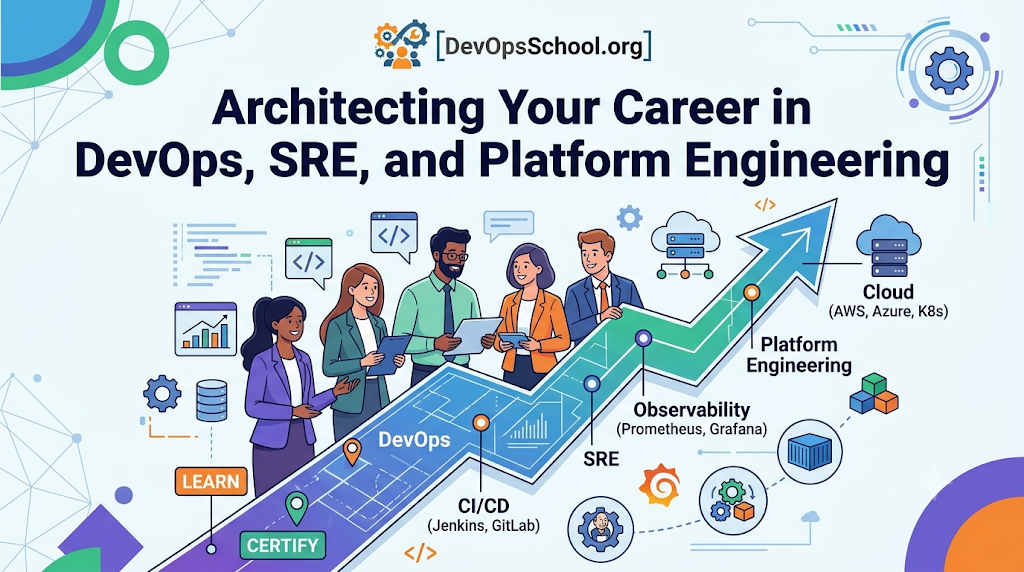
Introduction
Entering the field of DevOps can feel like attempting to navigate a vast, unstructured universe. Beginners and experienced professionals alike face a daunting array of tools, frameworks, and methodologies. A quick glance at modern software engineering job listings often reveals an overwhelming list of expectations: cloud platforms, container orchestration, automated pipelines, infrastructure provisioning, observability stacks, and security frameworks. Trying to master every tool simultaneously leads to burn-out, fragmented knowledge, and frustration.
A far more effective strategy is following a structured DevOps roadmap. By approaching the field as a step-by-step engineering progression rather than a frantic race to learn tools, you build a resilient knowledge base. A well-designed DevOps learning path helps you prioritize foundational engineering concepts before layering on automation, cloud architecture, and modern operational specializations.
Start With Engineering Fundamentals
Before touching advanced automation platforms or orchestrators, you must build a strong foundation in core software engineering principles. Tools come and go, but fundamental concepts remain stable across shifts in technology.
Linux and System Fundamentals
The vast majority of cloud workloads, containers, and enterprise infrastructure run on Linux. Mastering system administration basics is non-negotiable. You should become comfortable navigating the command line, managing filesystems, manipulating user permissions, analyzing system logs, and monitoring resource utilization (CPU, memory, disk I/O).
Networking Basics
Understanding how systems communicate across networks is essential for troubleshooting real-world issues. Focus on acquiring a solid grasp of:
- The OSI model and TCP/IP stack
- IP addressing, subnets, and routing
- DNS resolution, HTTP/HTTPS protocols, and status codes
- Firewalls, load balancers, and SSL/TLS encryption mechanisms
Source Control and Scripting
Version control is the bedrock of modern software delivery. You must master Git for tracking code changes, managing branches, resolving merge conflicts, and collaborating with development teams. Additionally, basic programming and scripting abilities—using Python, Bash, or Go—allow you to write custom automation scripts, interact with APIs, and extend existing operational tooling.
Build the Core DevOps Skill Set
Once system and networking fundamentals are secured, you can begin constructing your core operational toolset. A modern DevOps engineer roadmap focuses on how code transitions from an engineer’s laptop to a production environment safely, repeatedly, and predictably.
Engineering Fundamentals
       │
       ▼
Version Control & Code Management
       │
       ▼
Automated Build & Test (CI)
       │
       ▼
Containerization & Cloud Delivery (CD)
       │
       ▼
Infrastructure as Code & Configuration
       │
       ▼
Observability, Security & Reliability
This progression ensures that every layer of skill builds directly upon the previous one. First, you master managing source code with Git. Next, you implement Continuous Integration (CI) to build and test that code automatically whenever changes are committed. Continuous Delivery and Deployment (CD) then take over to manage release pipelines, deploying built packages into target environments.
As application architectures scale, containerization becomes critical for packaging software along with its dependencies. Containers provide consistency across development, testing, and production environments. Once containerized applications are ready for deployment at scale, infrastructure management transitions from manual provisioning to programmatic declaration, enabling predictable and reproducible environments.
Learn Tools Through Practical Problems
Technology tools exist to solve specific operational and architectural problems. Rather than trying to memorize commands in isolation, evaluate DevOps tools within the context of the engineering challenges they solve.
- Source Control: Git platforms (GitHub, GitLab, Bitbucket) solve code collaboration, history tracking, and peer review challenges.
- CI/CD Automation: Systems like Jenkins, GitHub Actions, and GitLab CI resolve manual deployment bottlenecks by automating build, test, and release workflows.
- Containerization & Orchestration: Docker solves local environment variance (“it works on my machine”), while Kubernetes resolves complex container management issues like auto-scaling, self-healing, and service discovery.
- Infrastructure as Code (IaC): Tools like Terraform and OpenTofu replace manual console clicks with version-controlled infrastructure definitions.
- Configuration Management: Ansible and Puppet automate server configuration, ensuring consistency across hundreds of virtual instances.
- Observability & Security: Prometheus, Grafana, and open-source security scanners provide visibility into system metrics while catching security vulnerabilities early in the delivery pipeline.
How to Compare DevOps Tools
With dozens of technologies serving overlapping functions, performing a thoughtful DevOps tools comparison is a critical skill for engineers and technical leads. When evaluating software options for your pipeline or team, consider the following operational factors:
| Evaluation Factor | Primary Considerations |
| Primary Purpose | Does the tool solve your specific architectural problem or add unnecessary complexity? |
| Deployment Model | Is it self-hosted, cloud-native, or available as a managed SaaS solution? |
| Ecosystem & Integrations | Does it integrate natively with your current cloud providers and source code repositories? |
| Learning Curve | How steep is the initial onboarding effort for your engineering team? |
| Operational Complexity | What is the maintenance overhead required to keep the tool secure and updated? |
| Community Support | Is there robust documentation, an active user base, and regular software releases? |
Avoiding unsupported claims about a single “best” tool allows you to select technologies based on pragmatic engineering trade-offs rather than marketing hype.
Move Toward Reliability and Operations
As software systems grow, keeping them running smoothly becomes an active engineering discipline. While DevOps focuses on breaking down silos between development and operations, Site Reliability Engineering (SRE) applies software engineering practices directly to operational problems.
An SRE roadmap introduces key concepts designed to keep distributed systems stable:
- Service Level Indicators (SLIs) & Objectives (SLOs): Defining clear, quantifiable metrics for application health and reliability.
- Error Budgets: Balancing rapid feature delivery with acceptable system risk.
- Observability & Alerting: Collecting metrics, logs, and traces to diagnose system anomalies before they impact end users.
- Incident Management: Implementing structured post-mortem reviews and automated remediation to prevent repeat outages.
SRE practices extend core operational workflows by prioritizing system uptime, capacity planning, and resilience.
Explore Platform Engineering
As enterprise engineering organizations grow, managing cloud infrastructure and deployment pipelines can become burdensome for application developers. Platform Engineering addresses this by creating internal developer platforms (IDPs) that offer self-service capabilities.
Following a Platform Engineering roadmap is typically a logical step for experienced engineers who already understand core infrastructure, CI/CD, and orchestration. Platform engineers build automated templates, standardized infrastructure patterns, and self-service portals. This enables development teams to provision environments, run tests, and deploy applications safely without needing deep expertise in underlying cloud infrastructure.
Understand Certifications Strategically
Industry credentials can validate your knowledge, but they are most effective when paired with real-world technical skills. When reviewing DevOps certifications, approach them as structured learning frameworks rather than golden tickets to employment.
A practical DevOps certification roadmap aligns credential goals with your current career stage:
- Entry to Associate Level: Foundational cloud certifications (e.g., AWS Certified Cloud Practitioner, Microsoft Certified: Azure Fundamentals) validate basic cloud concepts and terminology.
- Professional & Technical Level: Practitioner credentials (e.g., AWS Certified DevOps Engineer, Certified Kubernetes Administrator) test your ability to build, secure, and maintain actual production systems.
When choosing a certification path, review the domain requirements, preparation materials, exam formats, and renewal schedules carefully to ensure the credential supports your immediate learning goals.
Build Projects Before Chasing Every Tool
Hands-on project work is the most effective way to consolidate your learning. Instead of attempting to learn every tool on the market, build a few comprehensive projects that simulate real production workflows:
- Automated CI/CD Pipeline: Create a GitHub repository that automatically builds, tests, and lints a web application upon every pull request.
- Containerized Application Deployment: Package a multi-tier web application into containers and orchestrate local development using container manifests.
- Infrastructure Provisioning via IaC: Write Terraform configurations to deploy a public cloud environment equipped with virtual networks, compute instances, and load balancers.
- Observability Stack Integration: Deploy Prometheus and Grafana to collect metrics, build visual dashboards, and configure alerts for application downtime.
Document your project architecture, design choices, trade-offs, and troubleshooting steps in your code repositories. Detailed documentation demonstrates technical competence and engineering maturity to potential employers.
Connect Learning With Career Preparation
Navigating available DevOps jobs requires presenting a balanced combination of technical capabilities, system design knowledge, and problem-solving skills. Employers look for candidates who can analyze complex failure modes, communicate technical concepts clearly, and collaborate effectively across teams.
Prepare for technical interviews by reviewing core system design principles, practicing interactive command-line troubleshooting, and refining your public code portfolio. Demonstrating how you diagnose system bottlenecks, secure pipelines, and manage production failures carries significantly more weight during interviews than simply memorizing command syntax.
How DevOpsSchool.org Can Support the Learning Journey
For engineers seeking structured guidance, DevOpsSchool.org serves as a free and open software engineering learning and career platform. The site provides organized learning paths across disciplines including DevOps, SRE, Platform Engineering, DevSecOps, and FinOps.
Learners can use the platform’s resources to research technology directories, explore tool comparisons, examine certification requirements, and review career-navigation materials. Whether you are validating exam formats, preparing for technical interviews, or looking for practical guidance to structure your personal projects, DevOpsSchool.org offers clear reference materials to support your ongoing professional development.
Practical DevOps Learning Framework
Use this structured sequence to guide your learning journey step-by-step:
- Fundamentals: Learn Linux system administration, networking basics, Git, and shell scripting.
- Automation & CI/CD: Master automated build, test, and release pipelines using modern continuous integration tools.
- Containerization: Learn to package applications and their dependencies using container engines.
- Cloud Computing: Understand cloud infrastructure provisioning, virtual networks, identity management, and storage.
- Orchestration: Study Kubernetes for managing containerized workloads at scale.
- Infrastructure as Code: Automate cloud infrastructure setup using declarative configuration tools.
- Observability: Implement metrics collection, log aggregation, tracing, and automated alerting.
- Security & Reliability: Embed security practices into your pipelines (DevSecOps) and implement SRE concepts like SLOs and error budgets.
- Specialization & Career Prep: Focus on Platform Engineering or advanced SRE practices, build complete project portfolios, and prepare for technical interviews.
Common Mistakes to Avoid
- Learning Too Many Tools at Once: Trying to learn dozens of technologies simultaneously without mastering underlying engineering concepts leads to surface-level understanding.
- Skipping Linux and Networking: Attempting to learn Kubernetes or cloud platforms without solid Linux and networking basics makes troubleshooting production errors exceptionally difficult.
- Collecting Certifications Without Hands-On Experience: Rushing to earn credentials without building real projects creates a gap between theoretical knowledge and practical execution.
- Copying Tutorials Without Understanding: Following step-by-step guides without understanding the underlying commands or architectural decisions limits your ability to solve novel problems.
- Ignoring Documentation and System Architecture: Focusing exclusively on tool execution while neglecting technical writing, system design, and documentation practices limits career progression.
FAQs
How long does it take to learn DevOps?
Learning core DevOps skills typically takes 6 to 12 months of consistent study and practical application. The timeline varies based on your prior experience in software development, system administration, or networking.
Should beginners learn cloud computing before Kubernetes?
Yes. Understanding fundamental cloud concepts, such as virtual networking, compute instances, storage, and identity management, provides essential context for managing container orchestration platforms like Kubernetes.
Are certifications mandatory for securing a DevOps role?
No. While certifications help validate your technical knowledge, employers prioritize hands-on experience, practical problem-solving capabilities, and a portfolio of real-world projects over credentials alone.
What should I include in a beginner DevOps portfolio?
A strong portfolio should showcase public Git repositories featuring a containerized application, automated CI/CD pipelines, Infrastructure as Code scripts, monitoring configurations, and detailed architectural documentation.
How do I choose between DevOps, SRE, and Platform Engineering?
Focus on core DevOps practices first to build your base skills. If you enjoy system stability, incident management, and scaling systems, consider SRE. If you prefer building internal developer tools, infrastructure templates, and self-service portals, explore Platform Engineering.
Conclusion
Building a successful career in modern software engineering requires a structured, practical approach. By prioritizing foundational skills in Linux, networking, and version control before progressing into cloud automation, container orchestration, and Infrastructure as Code, you establish a strong technical base that adapts as individual tools evolve. Supplementing your theoretical knowledge with real-world projects and thoughtful specialization—whether in SRE or platform engineering—prepares you to solve complex enterprise challenges.
Resources like DevOpsSchool.org offer free, structured learning paths, technology research guides, and career preparation materials to support your engineering journey every step of the way. Focus on steady, practical progression, solve real engineering problems, and let your hands-on work demonstrate your technical capabilities.