Introduction
Every time a mobile device connects to a cellular tower, a quiet digital handshake takes place. Whether a smartphone is connecting to a home carrier in London, roaming onto a partner network in Tokyo, or provisioning a travel data profile via software, the cellular radio does not search for familiar commercial brand names. It searches for numbers.
These numbers are standardized telecommunications identifiers. They tell the device which country it is operating in, which network infrastructure is transmitting the signal, and whether the subscriber’s SIM card has permission to attach to that specific radio channel.
For developers building connectivity applications, network engineers managing international roaming agreements, IoT fleet managers, and telecommunications analysts, understanding these numeric foundations is critical. Public telecommunications references, including resources like eSIMGlobo, help users make sense of these complex records. By looking closely at how cellular identifiers are structured, assigned, and verified, anyone working with global connectivity can better navigate mobile network data.
The Core Identifiers Behind Cellular Routing
Cellular networks rely on global standards established by international governing bodies, primarily the International Telecommunication Union (ITU). Recommendation ITU-T E.212 defines the international identification plan used for mobile terminals and mobile networks. At the heart of this system sits the International Mobile Subscriber Identity (IMSI) and the Public Land Mobile Network (PLMN) identity.
+-------------------------------------------------------------------+
|               International Mobile Subscriber Identity            |
|                                (IMSI)                             |
+---------------------------------+---------------------------------+
|      PLMN Identifier            |  Mobile Subscription            |
|                                 |  Identification Number (MSIN)   |
+---------------+-----------------+---------------------------------+
| Mobile Country|  Mobile Network | Identifies the individual SIM   |
|   Code (MCC)  |    Code (MNC)   | or subscriber profile           |
|   (3 digits)  |  (2 or 3 digits)|                                 |
+---------------+-----------------+---------------------------------+
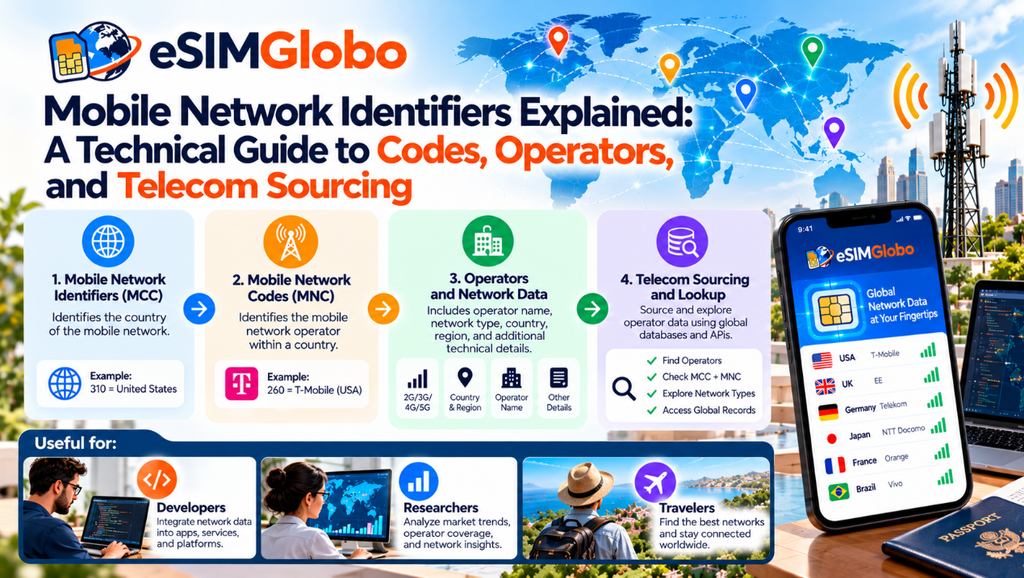
Mobile Country Codes (MCC)
The Mobile Country Code consists of three decimal digits. Its primary function is to identify a specific country, geographic area, or global network service. For example, codes starting with 2 typically represent European nations, codes starting with 3 designate North America and parts of the Caribbean, and codes beginning with 4 cover parts of Asia.
It is essential to distinguish an MCC from an E.164 telephone calling country code. While the United Kingdom uses the telephone dialing country code +44, its assigned mobile country code under E.212 is 234 (with additional ranges such as 235). Similarly, while the United States and Canada share the international calling prefix +1, they use entirely different mobile country codes: the United States uses codes in the 310, 311, 312, 313, and 316 ranges, while Canada uses 302.
Mobile Network Codes (MNC)
The Mobile Network Code consists of two or three decimal digits. Administered by national telecommunications authorities within their respective jurisdictions, the MNC identifies a specific mobile network within the territory designated by the MCC.
MNC lengths vary by region. In Europe and much of the world, two-digit MNCs are standard. In North America and specific other regions, three-digit MNCs are standard practice. A common pitfall in telecom data management is treating MNC formatting as interchangeable; 01 and 001 are technically distinct representations that must be handled with strict adherence to regional regulatory filings.
The Unified PLMN Identifier
When combined, the MCC and MNC form the Public Land Mobile Network (PLMN) identity. A complete PLMN code contains five or six digits.
When conducting an MCC MNC Lookup, researchers examine the exact combination of these two values to determine which organization holds the regulatory right to broadcast that identity over radio frequencies. A device reads the PLMN code broadcast over the network’s system information blocks (SIB) and matches it against the Home PLMN (HPLMN) list stored on the SIM card. If the codes match, the device registers as a local subscriber. If they do not match, the device evaluates available roaming profiles and bilateral roaming agreements.
Verifying Network Assignments and Operator Records
Connecting a numeric network code to a real-world entity requires navigating official telecommunications filings. National regulatory authorities—such as the FCC in the United States, Ofcom in the United Kingdom, or BNetzA in Germany—receive applications from telecommunications operators and issue formal assignments.
Performing a PLMN Code Lookup allows network analysts to connect raw signaling logs to an officially registered legal entity. However, interpreting this data requires understanding the difference between an official assignment and commercial reality.
| Metric / Attribute | Official Network Assignment | Commercial Network Operation |
| Primary Identifier | MCC + MNC (PLMN Code) | Retail Brand Name / Trade Name |
| Regulatory Purpose | Spectrum licensing and signaling routing | Consumer marketing and billing |
| Assigned To | Legal corporate entity | Consumer-facing brand (often subsidiary) |
| Verification Source | ITU-T E.212 lists & national regulators | Retail availability, coverage maps, stores |
| Status Changes | Administrative revocation / reallocation | Rebranding, promotional churn, MVNO pivots |
An assignment on paper does not guarantee that radio towers are currently transmitting that code. Regulators frequently assign codes for:
- Technical trials and non-commercial network testing.
- Private industrial networks (such as mining, shipping ports, or private enterprise campuses).
- Municipal transit networks and emergency services.
- Companies that held licenses but later merged, ceased operations, or entered bankruptcy.
Relying on a curated Mobile Network Operator Directory helps technical teams determine which operating entity holds the legal assignment for a network code, backed by documented verification sources and historical filings.
Navigating Geographic Scope and Regional Assignments
Organizing telecommunications data by country provides critical context for global operations. A centralized Mobile Country Code List serves as the primary index for regional technical filings, establishing clear boundaries for geographic analysis.
[ITU-T E.212 Recommendation]
         │
         ├── Geographic MCC Assignments (e.g., 208 = France, 440 = Japan)
         │       └── Managed by National Regulators (ARCEP, MIC)
         │               ├── MNC 01 -> Operator A
         │               └── MNC 02 -> Operator B
         │
         └── Non-Geographic MCC Assignments (e.g., 901 = International / Global)
                 └── Managed Directly by the ITU
                         ├── MNC 12 -> Satellite / Maritime Service
                         └── MNC 45 -> Global IoT / Transnational Service
Researchers exploring Mobile Network Codes by Country must account for several regulatory variations:
- Shared Geographic Codes: While most MCCs map to a single country or sovereign territory, exceptions exist. Small administrative regions, territories, or dependencies may share code space or maintain distinct codes for regulatory tracking.
- Multiple Codes per Country: Large markets with high densities of operators often exceed the capacity of a single MCC. The United States uses multiple three-digit prefixes (
310,311,312,313,316) to distribute assignments across regional carriers, national networks, and utility providers. - Non-Geographic Codes: The ITU reserves specific MCC ranges for global, non-geographic services. The
901and902ranges, for example, do not belong to any single country. Instead, the ITU assigns codes within these ranges directly to maritime operators, satellite communications providers, aeronautical networks, and international enterprise IoT providers.
Understanding these distinctions prevents false assumptions when configuring routing policies, billing verification systems, or device firmware.
Operators, Infrastructure, and Virtual Relationships
A common misconception in the telecommunications sector is that every mobile brand operates its own physical cellular towers, radio equipment, and fiber backhaul. In reality, the mobile ecosystem separates infrastructure ownership from retail service delivery.
Mobile Network Operators (MNO)
A Mobile Network Operator owns or controls the core network elements, radio access networks (RAN), and licensed radio spectrum necessary to transmit cellular signals. MNOs hold primary spectrum licenses granted by federal governments and manage physical base stations. These operators are almost always assigned one or more dedicated MNCs to identify their physical infrastructure.
Mobile Virtual Network Operators (MVNO)
A Mobile Virtual Network Operator provides mobile voice, SMS, and data connectivity to end users without owning physical radio spectrum or cell towers. Instead, an MVNO negotiates wholesale access agreements with established MNOs to route traffic across the host operator’s physical antennas.
Because virtual networks operate under varying technical configurations, their identifier arrangements differ substantially:
- Full MVNOs: These organizations own and operate their own packet core, home subscriber server (HSS), and switching systems. A Full MVNO often secures its own independent MNC from the national regulator. This enables the virtual operator to issue proprietary SIM cards and negotiate its own international roaming agreements.
- Light MVNOs: These providers focus primarily on retail distribution, customer care, and billing. They rely completely on the host operator’s core infrastructure. A Light MVNO typically does not hold a separate MNC; its subscribers’ SIM cards carry the host MNO’s network code.
Consulting an MVNO Directory helps connectivity researchers distinguish between businesses that own physical infrastructure and those that deliver services through wholesale carrier relationships. Understanding these structural tiers is essential for evaluating network redundancy, service coverage, and latency expectations.
Data Quality, Archival History, and Telecom Records
Because international telecommunications networks evolve continuously through mergers, spectrum reallocations, corporate restructurings, and operator liquidations, static lists quickly become obsolete.
Maintaining a structured Telecom Operator Database requires systematic documentation, cross-referencing, and continuous verification. High-quality telecom record management depends on several fundamental practices:
[Data Ingestion] ---> [Regulatory Cross-Check] ---> [Verification Review] ---> [Documented Entry]
National Filings       ITU E.212 Bulletins          Active Status Check        Source References
Operator Gazettes      Carrier Disclosures          Conflict Resolution        Historical Changelog
1. Transparent Source Attribution
Every data point—whether an assigned MNC, an operating company name, or an administrative status—must reference an authoritative primary source. Trustworthy repositories cite official bulletins from the ITU, public registers from national telecommunications ministries, or formal carrier disclosures.
2. Historical Tracking and Status Flags
Networks change over time. When one carrier acquires another, network codes may remain active for years during network integration before being decommissioned or reallocated. A reliable telecom dataset preserves historical assignments, clearly distinguishing between operational networks, decommissioned codes, and unallocated test reserves.
3. Structural Consistency
Data normalization is essential for engineering workflows. A reference directory must standardize capitalization, company legal designations, country codes (such as ISO 3166-1 alpha-2 and numeric codes), and the numerical padding of two-digit versus three-digit MNCs.
Platforms like eSIMGlobo focus on these data verification practices. By cataloging operator assignments alongside documented verification sources and geographic data, such directories provide researchers with a transparent, structured reference tool for evaluating telecom records.
Evaluating eSIM Platforms and Modern Connectivity Services
The transition from physical plastic SIM cards to embedded SIMs (eSIM) and integrated SIMs (iSIM) has transformed how devices connect to networks. Built on GSMA specifications, eSIM technology allows devices to download and install operator profiles over the air using Remote SIM Provisioning (RSP) architectures.
+--------------------------------------------------------------------------+
|                        eSIM Provisioning Flow                            |
+--------------------------------------------------------------------------+
|  [eSIM Profile Provider / Retailer]                                      |
|       │  Negotiates wholesale capacity from MNOs/MVNOs                   |
|       ▼                                                                  |
|  [SM-DP+ Server (Subscription Manager Data Preparation)]                 |
|       │  Generates encrypted profile containing IMSI (MCC + MNC)        |
|       ▼  Delivered via QR code or LPA activation code                    |
|  [eUICC Chip on Device]                                                  |
|       │  Stores profile securely in embedded hardware                    |
|       ▼                                                                  |
|  [Local Radio Attachment]                                                |
|          Scans local towers matching the provisioned PLMN                |
+--------------------------------------------------------------------------+
As the commercial consumer and enterprise market for travel profiles expands, an eSIM Provider Directory allows users and researchers to review the market of digital connectivity providers. When evaluating any eSIM service, technical analysts and travelers should examine several key attributes:
- Underlying Wholesale Network: An eSIM brand rarely owns physical cell towers across the globe. Most act as digital aggregators or MVNOs that purchase wholesale roaming profiles from international transit carriers.
- Routing and Latency: Because travel eSIM profiles often route data through a central home gateway, traffic may experience latency. For example, a consumer using a European travel profile in Asia might experience high packet round-trip times if the underlying carrier routes data back through a server located in Frankfurt or London.
- Profile Capabilities: Some profiles support cellular data only, lacking standard mobile numbers, voice channels, or SMS support. Other enterprise profiles support multi-IMSI switching, allowing an IoT device to switch network identities automatically when borders are crossed.
Directories that catalogue network assignments and those that track commercial service providers serve complementary functions: one tracks foundational network identities, while the other maps the commercial ecosystem delivering connectivity to end users.
Engineering Workflows and Technical Data Applications
Structured telecom identifier data plays a crucial role across enterprise systems, cybersecurity architectures, and software engineering workflows.
1. Mobile Application Localization and Telephony Routing
Applications managing international customer bases use mobile network data to validate user input, route telephone calls efficiently, and detect user countries without relying solely on high-power GPS hardware. By reading the SIM’s MCC and MNC values, an application can identify the user’s home network and configure region-specific settings accordingly.
2. Fraud Prevention and Risk Scoring
Financial institutions and identity verification platforms use network identifiers to combat SIM-swap fraud and international account takeovers. A sudden mismatch between a subscriber’s registered home PLMN, current network signaling, and country assignment often triggers elevated risk scoring, prompting secondary security challenges before processing transactions.
3. IoT Fleet Management and Roaming Optimization
Industrial IoT hardware operating across multiple countries depends on accurate identifier records. Connected devices rely on pre-programmed PLMN preference lists to prioritize low-cost, high-reliability roaming partners while avoiding networks with poor service-level agreements.
To support these high-volume use cases, developers often rely on programmatic integration. An MCC MNC Lookup API allows software systems to automate the resolution of raw network codes into structured records, enabling applications to validate carrier data, enrich log files, and support connectivity workflows directly in their codebases.
Navigating Telecom Data: A Practical Verification Checklist
Because telecom data changes across national borders and regulatory jurisdictions, analysts should approach network records systematically. Before relying on a mobile network code for billing, engineering, or legal research, verify the record using this structured process:
- Verify Against National Regulators: Confirm whether the specific MCC/MNC combination appears in the official allocation table published by the national telecommunications regulator of the host country.
- Review the International Status: Cross-check the record against the ITU-T Operational Bulletin updates published regularly by the International Telecommunication Union.
- Confirm the Assignee Entity: Check whether the legal entity holding the assignment corresponds to an active operating company, a holding entity, or a business that has completed a corporate merger.
- Inspect the MNC Format: Preserve leading zeros. Ensure that three-digit codes (e.g.,
001) are not compressed into two-digit formats (01) or converted into plain numerical integers that strip structural formatting. - Differentiate Assignees from Brands: Clarify whether the target research subject is the infrastructure owner holding the radio license or a commercial retail brand operating as an MVNO.
- Check Documented Record Dates: Determine when the dataset was last reviewed against primary sources. Telecom records that lack source references or update histories can lead to incorrect conclusions regarding live network operations.
A curated Global Telecom Provider Directory simplifies this process by organizing disparate regulatory filings, commercial records, and technical assignments into a single, structured interface.
Frequently Asked Questions
What is the difference between an MCC and an MNC? An MCC (Mobile Country Code) is a three-digit number defining a country, geographic territory, or global service under ITU-T Recommendation E.212. An MNC (Mobile Network Code) is a two- or three-digit number assigned by national telecommunications regulators to identify a specific mobile network operator or virtual operator within that region.
What is a PLMN code? A Public Land Mobile Network (PLMN) code is the combination of an MCC and an MNC. It forms a unique five- or six-digit identifier that a mobile device uses to recognize and connect to an authorized mobile network operator.
Does a registered network code guarantee active cell coverage? No. A registered code assignment indicates that a regulatory body has allocated that identifier to a specific organization. The organization may use the code for private testing, industrial applications, or enterprise services, or the code may remain dormant following a corporate merger or network decommissioning.
How does an MVNO differ from an MNO? A Mobile Network Operator (MNO) owns physical spectrum licenses, core infrastructure, and radio towers. A Mobile Virtual Network Operator (MVNO) provides connectivity to consumers by leasing network capacity from an MNO under wholesale commercial agreements, rather than deploying its own physical radio access network.
Are telephone dialing country codes the same as Mobile Country Codes? No. International telephone dialing codes follow ITU-T Recommendation E.164 (such as +1 for North America or +33 for France). Mobile Country Codes follow ITU-T Recommendation E.212 (such as 310 through 316 for the United States, and 208 for France). They serve different routing functions in telecommunications architecture.
Why do some Mobile Network Codes have leading zeros? MNCs are defined as specific character strings rather than numerical quantities. A two-digit code such as 02 or a three-digit code such as 002 relies on leading zeros to remain distinct under signaling standards. Converting these strings into plain numbers strips essential formatting and can disrupt automated lookups.
How do global or non-geographic MCC assignments work? The ITU allocates specific non-geographic codes, such as MCC 901 and 902, for international services that operate across multiple territories. These codes identify maritime connectivity, inflight passenger networks, satellite constellations, and global enterprise IoT platforms that do not belong to a single country.
How can developers automate mobile network code lookups? Developers integrate telecommunications reference data into software applications using structured lookup interfaces or specialized data endpoints. These tools allow software systems to resolve raw signaling strings into verified operator names, country codes, and regulatory records automatically.
Summary
Modern cellular communications rely on the structured numbering systems defined by ITU-T Recommendation E.212. The interaction between Mobile Country Codes, Mobile Network Codes, and unified PLMN identities allows billions of mobile devices to navigate complex global networks seamlessly.
Navigating these telecommunications identifiers requires a clear distinction between administrative regulatory filings, physical radio access infrastructure, and consumer-facing retail brands. While an MNO manages spectrum and physical towers, virtual operators and modern eSIM providers deliver dynamic connectivity via wholesale partnerships.
Platforms like eSIMGlobo support this ecosystem by compiling operator directories, regulatory assignments, and country-level network references into accessible research tools. By relying on primary regulatory documentation, verifying data sources, and respecting structural numbering standards, developers, network engineers, and industry professionals can analyze global telecom records with confidence.