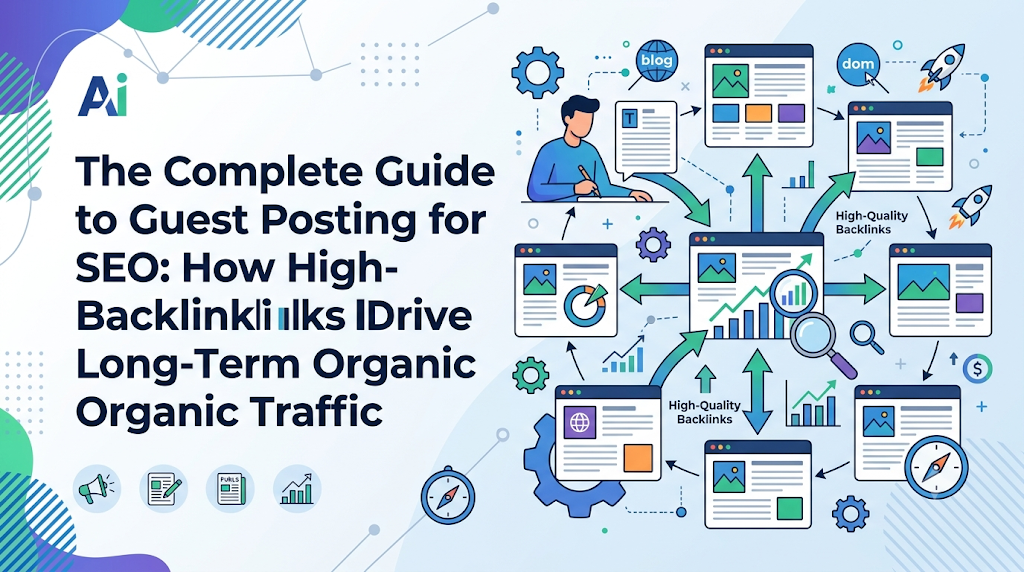
Introduction
Organic traffic serves as the primary driver of sustainable digital growth. Unlike paid advertising channels that cease delivering visitors the moment budget allocations dry up, organic search traffic provides a compounding return on investment. Achieving consistently high organic search engine rankings requires navigating complex algorithm updates, competitive SERPs, and rising content production standards.
Publishing exceptional content on your own domain is rarely enough on its own. Modern search engines evaluate a website’s trust, credibility, and authority by examining its off-page presence.
This is where guest posting functions as a powerful digital marketing channel. When executed strategically, guest posts do not merely secure links; they establish brand authority, route qualified audiences, and signal relevance to search engines.
This guide breaks down exactly how guest posts improve organic traffic, explore the underlying mechanics of search visibility, provide actionable execution frameworks, and demonstrate how platforms like GuestPostAI.com streamline off-page SEO campaigns for maximum growth.
Understanding Organic Traffic and Its Business Value
What Is Organic Traffic?
Organic traffic refers to visitors who land on your website as a direct result of unpaid (“organic”) search results. When a user enters a query into Google, Bing, or another search engine, the search engine displays a ranked list of relevant web pages. When a user clicks on one of these unpaid listings, that visit is classified as organic search traffic.
Why Organic Traffic Matters for Businesses
Organic search is the most valuable traffic source for online businesses due to four core attributes:
- High Intent and Quality: Search users actively look for answers, products, or solutions. They exhibit higher conversion rates compared to passive social media scrollers.
- Cost Efficiency: While acquiring organic rankings requires upfront investments in content and off-page SEO, the marginal cost per acquired visitor decreases significantly over time.
- Compounding Longevity: High-ranking content can capture traffic for months or years without ongoing ad spend.
- Trust and Credibility: Users inherently place more trust in top organic search results than in labeled ad placements.
Industry Benchmark: Search engine industry studies consistently show that over 53% of all web traffic originates from organic search, and the top three organic results capture over 54% of all user clicks.
The Fundamentals of Guest Posting for SEO
What Is Guest Posting?
Guest posting (or guest blogging) is the practice of creating and publishing content on an external, third-party website or publication within your industry niche. In exchange for providing valuable, informative content to the host publisher’s audience, the guest author typically receives an author attribution and a contextual backlink back to their own website.
How Guest Posting Supports SEO Growth
Search engines rely on complex algorithmic systems to determine which pages deserve top rankings. One of the primary foundational ranking factors remains the quantity and, more importantly, the quality of external websites linking to your domain. Guest posting acts as an active, ethical bridge between off-page authority building and on-page topical optimization.
+---------------------+     High-Value Contextual Link     +---------------------+
| Host Website        | =================================> | Your Target Website |
| (Established DA/DR) |     Passes Authority & Relevance   | (Organic Visitor)   |
+---------------------+                                    +---------------------+
The Relationship Between Guest Posts and Search Engine Rankings
When a reputable host publication links to your site within a contextual guest post:
- Search engine web crawlers discover and follow the hyperlink.
- The host site passes a portion of its equity (often referred to as PageRank or link equity) to your page.
- Search engine algorithms register this link as an endorsement or vote of confidence.
- Your target URL accumulates authority, lifting its positional rankings across target search engine results pages (SERPs).
- Higher SERP positions directly convert into increased organic impressions and user clicks.
Core SEO Concepts: Backlinks, Authority, and Visibility
To fully understand how guest posts improve organic traffic, you must understand three core SEO concepts: link equity, domain authority, and topical relevance.
How High-Quality Backlinks Influence Organic Visibility
Not all backlinks carry equal weight. A single link from a well-established, highly relevant publication within your industry carries vastly more algorithmic value than dozens of links from generic, low-quality, or unrelated websites. High-quality backlinks validate your domain’s trust profile, accelerating indexing speed and improving overall search visibility.
Domain Authority and Topical Authority Explained
- Domain Authority (DA/DR): Third-party metrics (developed by Moz and Ahrefs respectively) designed to predict a domain’s ranking strength based on its total backlink profile and link diversity.
- Topical Authority: A search engine’s assessment of how comprehensively a domain covers a specific niche topic. Guest posts published on niche-relevant sites reinforce your site’s topical authority by connecting your domain to contextually related entities across the web.
               +--------------------------------------+
               |          Topical Authority           |
               +--------------------------------------+
                                  |
         +------------------------+------------------------+
         |                                                 |
         v                                                 v
+---------------------------------+               +---------------------------------+
|        On-Page Structure        |               |      Contextual Guest Posts     |
| Comprehensive Niche Coverage   |               | High-Relevance Backlink Signal  |
+---------------------------------+               +---------------------------------+
Referral Traffic vs Organic Traffic
While the primary objective of SEO-driven guest posting is acquiring backlink equity to boost search rankings, guest posts also generate direct referral traffic.
- Referral Traffic: Direct clicks from users reading your guest post on the publisher’s site who follow your link.
- Organic Traffic: Indirect traffic growth resulting from your owned pages ranking higher in Google search results as a direct consequence of the backlink equity gained.
Content Distribution and Brand Visibility
Publishing content on established industry platforms introduces your brand to existing, highly engaged communities. This distribution broadens brand search demand (users typing your brand name into Google), generating direct positive signals that search algorithms associate with authority and market prominence.
How Guest Posts Help Improve Organic Traffic
This core section details the mechanics of how strategic guest posting directly powers sustained organic traffic growth.
+-----------------------------------------------------------------------------------+
|                        HOW GUEST POSTS DRIVE ORGANIC TRAFFIC                      |
+-----------------------------------------------------------------------------------+
| 1. High-Quality Backlinks  ===> Passes link equity and establishes site trust     |
| 2. Increased Search Authority===> Raises site-wide baseline rankings              |
| 3. Improved Keyword Position ===> Moves pages into top-3 high-click positions     |
| 4. Expanded Content Reach  ===> Contextually exposes target URLs to web crawlers  |
| 5. New Audience Exposure   ===> Converts readers into direct brand followers      |
| 6. Branded Search Volume   ===> Signals real-world brand presence to algorithms   |
| 7. Enhanced Topical Signal ===> Validates niche relevance and thematic alignment  |
| 8. Indexing & SEO Signals  ===> Speeds up discovery of newly published pages      |
| 9. Long-Term Digital Assets ===> Provides permanent backlink & referral value    |
+-----------------------------------------------------------------------------------+
1. Building High-Quality Backlinks
- SEO Impact: Contextual backlinks embedded naturally within body paragraphs pass maximum link equity. This elevates the specific target URL’s PageRank.
- Business Benefits: Elevates crucial landing pages higher on competitive search terms, lowering reliance on pay-per-click (PPC) ads.
- Practical Implementation: Ensure link placements use varied, natural anchor text that provides genuine editorial context rather than exact-match keyword stuffing.
2. Increasing Search Engine Authority
- SEO Impact: Accumulating contextual links from trusted host domains increases your site’s overall domain trust, making it easier for every published page to rank.
- Business Benefits: Reduces the time required for new blog posts and landing pages to index and achieve initial SERP rankings.
- Practical Implementation: Target guest posting sites that display consistent organic growth and clean backlink profiles.
3. Improving Keyword Rankings
- SEO Impact: Directing off-page link equity toward strategic target URLs helps move non-ranking or page-2 keywords into the top 3 positions on Google.
- Business Benefits: Placing main conversion pages into top organic positions dramatically increases qualified lead generation and sales revenue.
- Practical Implementation: Map each guest post backlink to a specific target page on your domain that requires a positional ranking boost.
4. Expanding Content Reach
- SEO Impact: Broadens the indexable reach of your web properties by securing mentions across diverse IP addresses and external web ecosystems.
- Business Benefits: Exposes your intellectual property, research, or solutions to wider industry networks.
- Practical Implementation: Syndicate key industry research data through guest articles on high-tier industry magazines.
5. Reaching New Audiences
- SEO Impact: Drives relevant users to your site who engage with content, lowering bounce rates and generating user-interaction signals.
- Business Benefits: Expands your top-of-funnel reach, growing your newsletter subscriber base and social media followings.
- Practical Implementation: Craft guest posts that address pressing user pain points, linking back to targeted resource pages on your site.
6. Increasing Branded Searches
- SEO Impact: A rise in branded search queries signals to search engines that your website is a trusted entity rather than an unverified site.
- Business Benefits: Builds brand equity, improves user recall, and maximizes conversion rates across marketing channels.
- Practical Implementation: Include clear brand citations, expert author bios, and unique industry commentary in every guest submission.
7. Supporting Topical Authority
- SEO Impact: Earning backlinks from publications exclusively focused on your industry reinforces the exact semantic context of your business.
- Business Benefits: Positions your firm as a recognized market leader in your specialized vertical.
- Practical Implementation: Prioritize topical alignment over generic metrics; a DR 40 niche-specific site often yields better topical signals than a DR 70 generic news aggregator.
8. Strengthening SEO Signals
- SEO Impact: Creates natural link patterns, diversifies referring domain networks, and introduces fresh crawling vectors for search engine bots.
- Business Benefits: Protects your domain against single-source link dependency and protects search positions during major core algorithm updates.
- Practical Implementation: Maintain a continuous, steady cadence of guest post acquisition rather than sporadic, high-volume link blasts.
9. Creating Long-Term Traffic Assets
- SEO Impact: Unlike paid campaigns, high-quality guest posts remain indexed permanently, passing continuous link equity over time.
- Business Benefits: Delivers long-term ROI, yielding organic clicks and backlink value long after the initial post creation cost.
- Practical Implementation: Partner with reputable host blogs that maintain high editorial standards and guarantee permanent article archiving.
Real-World Guest Posting Scenarios
The following practical scenarios demonstrate how strategic guest posts solve distinct organic traffic and ranking challenges across different business models:
Scenario A: A New Website Increasing Organic Traffic
- The Challenge: A newly launched domain suffers from the search engine “sandbox” effect, struggling to index or rank for competitive keywords due to zero site authority.
- The Strategy: The team secures 10 targeted guest posts over 90 days on DR 30–50 industry-specific blogs, linking to core informational guides.
- The Outcome: The backlink profile signals domain trust, decreasing average indexing time from weeks to hours and elevating initial keyword rankings onto SERP pages 1 and 2.
Scenario B: A SaaS Company Earning Authoritative Backlinks
- The Challenge: A B2B SaaS platform targeting competitive search terms remains stuck on page 2 behind legacy competitors.
- The Strategy: Using GuestPostAI.com, the team identifies software review publications and guest writes technical workflow guides that naturally feature their SaaS platform’s data.
- The Outcome: Earning 5 high-DR (70+) contextual backlinks moves the core product landing page into the top 3 ranking positions for high-intent keywords, driving a 140% surge in organic demo signups.
Scenario C: A Blogger Expanding Search Visibility
- The Challenge: A niche food blogger experiences plateaued organic search traffic despite publishing high-quality recipes weekly.
- The Strategy: The blogger guest posts on high-authority lifestyle sites, linking back to foundational hub pages (e.g., “Ultimate Meal Prep Guide”).
- The Outcome: Link equity transfers to the recipe hub, lifting long-tail keyword rankings site-wide and generating a 65% increase in monthly organic traffic.
Scenario D: A Business Improving Keyword Rankings
- The Challenge: A regional professional services firm ranks #8 for its primary revenue-generating keyword.
- The Strategy: The business executes an outreach campaign to regional business journals and trade blogs, placing guest articles on local industry trends.
- The Outcome: The localized authority signals push the target landing page to the #2 spot within 60 days, significantly increasing organic inbound inquiries.
Scenario E: A Content Marketing Campaign Generating Long-Term Traffic
- The Challenge: An e-commerce brand’s original research report receives little organic traction due to lack of initial distribution.
- The Strategy: The marketing team places guest posts summarizing the study’s key findings on major industry news portals, linking back to the full research report asset.
- The Outcome: External sites reference the guest posts and original research, generating secondary viral backlinks and a continuous stream of organic referral and search traffic.
Scenario F: A Niche Website Building Topical Authority
- The Challenge: A specialized renewable energy blog struggles to outrank general tech portals covering solar energy topics.
- The Strategy: The publishing team contributes guest posts exclusively to dedicated environmental science and clean-tech journals.
- The Outcome: The high topical relevance of referring domains validates the site’s authority in renewable energy, propelling its cluster content above broader tech domains.
Comprehensive SEO & Traffic Strategy Comparisons
Evaluating guest posting against alternative traffic acquisition strategies highlights its distinct role in an integrated growth plan.
Table 1: Guest Posting vs Paid Traffic
| Metric / Feature | Guest Posting (Organic Link Building) | Paid Traffic (PPC / Social Ads) |
|---|---|---|
| Traffic Duration | Long-term, compounding growth | Instant, stops immediately when budget ends |
| Cost Dynamics | High upfront investment, declining Cost Per Visit | Ongoing operational cost per click/impression |
| SEO Ranking Impact | Directly improves search authority & rankings | Zero direct impact on organic search rankings |
| Trust Factor | High credibility via third-party editorial validation | Lower user trust due to explicit “Sponsored” labels |
| Conversion Intent | High for organic searchers | Variable depending on targeting parameters |
Table 2: Guest Posting vs Social Media Traffic
| Metric / Feature | Guest Posting for SEO | Social Media Marketing |
|---|---|---|
| Primary Objective | Search engine rankings & backlink equity | Engagement, brand awareness, & short-term clicks |
| Content Lifecycle | Years (evergreen indexed articles) | Hours to days (feed depreciation) |
| Link Equity Value | Passes direct SEO value (PageRank) | Uses nofollow or redirected links (Zero direct PageRank) |
| Audience Intent | Active search intent | Passive browsing/feed consumption |
Table 3: High-Authority Backlinks vs Low-Quality Backlinks
| Evaluation Criteria | High-Quality Guest Post Backlinks | Low-Quality / Spam Backlinks |
|---|---|---|
| Publisher Metrics | Real organic traffic, high DR/DA, clean backlink profile | Zero organic traffic, artificial DA, spammy profile |
| Topical Relevance | Contextually aligned with your specific niche | Irrelevant, broad, or farm-like content networks |
| Editorial Standards | Strict guidelines, peer-reviewed, high content quality | Automated publishing, no editorial oversight |
| Risk Profile | Fully compliant with Google Webmaster Guidelines | High risk of manual actions or algorithmic penalties |
Table 4: Referral Traffic vs Organic Traffic
| Characteristic | Referral Traffic from Guest Posts | Organic Search Traffic |
|---|---|---|
| Source Channel | Direct clicks on hyperlinks in published articles | Search engine result page (SERP) listings |
| Immediate Impact | Rapid influx of visitors post-publication | Gradual growth as search engine rankings climb |
| Scalability | Tied directly to individual article readership | Highly scalable across thousands of monthly search queries |
| SEO Contribution | Proves real user engagement to algorithms | Primary goal and direct output of sustained SEO efforts |
Table 5: Short-Term Traffic vs Long-Term Organic Traffic
| Feature | Short-Term Traffic Strategies | Long-Term Organic Strategy (Guest Posts) |
|---|---|---|
| Primary Channels | Viral social posts, flash ad campaigns, PR blasts | SEO content, guest posts, contextual link building |
| Predictability | High volatility, erratic spikes and drop-offs | Consistent, predictable, and compounding growth curves |
| Asset Value | Low residual equity after initial launch | High long-term enterprise value and authority |
| Strategy Focus | Capturing short-term trending interest | Capturing permanent market search demand |
Step-by-Step Guest Posting Strategy for Organic Traffic Growth
Executing a high-ROI guest posting strategy requires an organized, process-driven workflow.
[Phase 1: Research] ──> [Phase 2: Qualification] ──> [Phase 3: Creation] ──> [Phase 4: Outreach] ──> [Phase 5: Tracking]
  - Keyword Mapping      - DR / Traffic Filters       - Niche Angle         - Personalized Pitch    - SERP Visibility
  - Target Selection     - Indexing Verification      - Contextual Links    - Editorial Sync        - Conversion Attrib.
Phase 1: Keyword Research and Target Selection
- Identify Target URLs: Select priority landing pages or informational posts that need authority to climb SERPs.
- Map Primary Keywords: Define primary and secondary keywords for each target URL to inform contextual anchor text strategies.
- Prospect Host Websites: Source industry-relevant blogs, online magazines, and niche publications using advanced search operators or outreach engines like GuestPostAI.com.
Phase 2: Host Website Qualification
Filter potential host domains against core quality thresholds:
- Organic Traffic Verification: Ensure the site receives steady, verified organic traffic via tools like Ahrefs or Semrush.
- Domain Metrics: Aim for a healthy Domain Rating (DR) and Domain Authority (DA) aligned with your link building budget.
- Topical Relevance: Confirm the host site regularly publishes content directly related to your vertical.
- Indexing Check: Ensure the site’s recent posts are indexed by Google.
Phase 3: Topic Ideation and Pitching
- Analyze Content Gaps: Identify topics missing on the host blog that align with your expertise.
- Craft Tailored Pitches: Reach out to editors with 2–3 unique pitch options designed to add genuine value to their readers.
- Highlight Value: Emphasize how your proposed article solves an end-user problem while adhering to their editorial guidelines.
Phase 4: High-Quality Content Creation
- Write In-Depth Content: Produce comprehensive, well-researched, human-centric articles that meet or exceed the host blog’s average publication length.
- Integrate Links Naturally: Insert your target link contextually within body copy where it logically enriches the reader’s understanding.
- Format for Readability: Use subheadings, short paragraphs, and bullet points for optimal mobile readability.
Phase 5: Publishing and Post-Launch Optimization
- Promote Published Posts: Share the published guest post across your own social networks and email newsletters to jumpstart initial referral traffic.
- Monitor Link Health: Track published guest URLs to ensure links remain
dofollowand fully indexed. - Iterate and Scale: Continuously refine your target criteria and outreach templates based on indexation speeds and SERP position gains.
How to Measure Organic Traffic Growth from Guest Posts
Tracking the performance of your guest posting efforts is essential for measuring return on investment (ROI) and refining ongoing SEO strategy.
+---------------------------------------------------------------------------------+
|                       KEY PERFORMANCE INDICATOR (KPI) METRICS                   |
+---------------------------------------------------------------------------------+
| Metric                   | Primary Tool               | Target Outcome          |
+--------------------------+----------------------------+-------------------------+
| Organic Sessions         | Google Analytics 4         | Steady YoY % Growth     |
| Keyword Rankings         | Google Search Console/Ahrefs| Upward SERP Movement    |
| Referring Domains        | Semrush / Ahrefs           | Diversified Link Growth |
| Domain Authority / Rating| Moz / Ahrefs               | Baseline Trust Lift     |
| Referral Conversions     | Google Analytics 4         | Direct Lead Generation  |
| Share of Voice (Visibility)| Search Console / AccuRanker| Expanded Impressions    |
+--------------------------+----------------------------+-------------------------+
1. Organic Sessions
Monitor Google Analytics 4 (GA4) for total organic sessions over a 30-, 60-, and 90-day horizon post-campaign. Compare organic growth trajectories against baseline period performance.
2. Keyword Rankings
Track movement for primary target keywords linked within guest posts. Movement from page 2 or 3 into positions 1–3 serves as direct proof of effective link equity transfer.
3. Backlink Growth and Referring Domains
Track the total volume of referring domains acquired. A steady, upward trajectory in referring domains correlates strongly with sitewide organic traffic growth.
4. Domain Metrics Trends
Observe progressive increases in Domain Authority (Moz) or Domain Rating (Ahrefs). While third-party metrics are proxies, steady upward trends indicate an improving backlink profile.
5. Referral Traffic and Conversion Tracking
Set up conversion events in GA4 to measure signups, lead forms, or sales driven by referral visitors originating directly from your guest posts.
6. Search Visibility Metrics
Monitor overall search impression counts in Google Search Console. An expanding impression foot-print often precedes actual click and traffic gains, indicating that search engines are recognizing your site’s expanded topical footprint.
Addressing Myths, Mistakes, and Ethical Compliance
Common Guest Posting Myths
- Myth 1: “Guest posting is dead.”Reality: Spammy, automated guest blogging designed purely to sell low-quality links is ineffective. High-value, editorially reviewed guest posting remains one of the most effective, white-hat SEO tactics available.
- Myth 2: “Only high-DR domains yield results.”Reality: A link from a DR 35 site with high topical relevance and active organic traffic often delivers more ranking value than an irrelevant DR 75 generic news site.
- Myth 3: “Exact-match anchor text is necessary for rankings.”Reality: Over-optimizing anchor text with exact-match keywords creates unnatural backlink profiles that risk algorithmic penalties. Natural, varied anchor text is safer and delivers more consistent results.
Mistakes That Prevent Guest Posts from Driving Traffic
- Publishing on Low-Quality Domains: Placing links on “link farms” or domains with artificial traffic leads to wasted budget and potential search penalties.
- Ignoring Topical Alignment: Building links on websites outside your target niche weakens the context of your backlink profile.
- Forcing Irrelevant Links: Inserting unnatural backlink anchor text harms readability, leading to editor rejections or link removals.
- One-And-Done Approach: Treating guest posting as a one-time project rather than an ongoing off-page strategy limits compounding growth.
Ethical Guest Posting and Google’s Guidelines
Google’s Search Essentials (formerly Webmaster Guidelines) strictly prohibit link schemes aimed at manipulating search rankings. To stay compliant:
- Focus on providing high-quality, original content that serves the host publication’s audience.
- Avoid large-scale, automated link schemes or low-quality sponsored link exchanges.
- Use natural anchor placement and respect publisher editorial decisions regarding link attributes (
rel="sponsored"orrel="nofollow") when commercial transactions occur.
The Future of Guest Posting for Organic Growth
As search engines increasingly prioritize EEAT (Experience, Expertise, Authoritativeness, and Trustworthiness), the quality threshold for guest posting continues to rise. Future-proof guest posting focuses on genuine thought leadership, original data sharing, verified author credentials, and strategic distribution via specialized platforms like GuestPostAI.com.
How GuestPostAI.com Accelerates Organic Traffic Growth
Navigating manual guest outreach can be resource-intensive, often bogged down by low publisher response rates, tedious site vetting, and inconsistent editorial quality. GuestPostAI.com simplifies off-page SEO with a platform designed to scale high-quality guest posting efficiently.
+---------------------------------------------------------------------------------+
|                        GUESTPOSTAI.COM WORKFLOW ENGINE                          |
+---------------------------------------------------------------------------------+
| [ Vetted Publisher Network ] -> [ AI-Assisted Content Workflows ]               |
|                                            |                                    |
|                                            v                                    |
| [ Measurable Organic Growth ] <- [ Scalable Outreach & Management ]             |
+---------------------------------------------------------------------------------+
How GuestPostAI.com Helps Businesses Increase Organic Traffic
- Guest Posting Opportunity Discovery: Access an expansive database of pre-vetted, high-authority host domains across diverse niches, eliminating manual prospect research.
- AI-Assisted Content Workflows: Leverage advanced content structuring engines to create editorially sound, highly relevant guest post drafts tailored to target publisher style guides.
- Streamlined Outreach Management: Eliminate cold outreach friction with automated, transparent workflow tools that connect advertisers with host publishers.
- SEO-Focused Link Building: Every placement option is evaluated for metric integrity, ensuring acquired links pass maximum authority to target landing pages.
- Scalable Campaign Execution: Scale your link-building campaigns predictably month-over-month, building a consistent backlink velocity that drives sustained organic growth.
Why Businesses Choose GuestPostAI.com
- Verified Publisher Quality: Every host site in the platform network undergoes screening for real organic search traffic, backlink health, and domain metric authenticity.
- Operational Efficiency: Reduce administrative overhead by up to 80%, allowing marketing teams to spend less time managing outreach spreadsheets and more time driving strategy.
- Data-Driven Matchmaking: Find host publications that match your niche, target DR parameters, and audience profile.
- Sustainable SEO Performance: Built around white-hat link acquisition practices, ensuring your backlink equity continues to yield compound organic traffic for years to come.
Actionable Guest Posting Checklist
Use this quick checklist to ensure every guest post campaign is optimized for maximum organic traffic performance:
- [ ] Target Selection: Verified host site receives active, real organic traffic from Google.
- [ ] Topical Alignment: Host publication content directly connects with your business vertical.
- [ ] Metric Health: Host domain possesses a clean backlink profile without spam spikes.
- [ ] Contextual Link Placement: Backlink is inserted naturally within the core body text.
- [ ] Anchor Text Diversity: Anchor text uses natural, descriptive phrasing rather than repetitive exact-match keywords.
- [ ] Content Integrity: The submitted article is original, comprehensively researched, and free of automated fluff.
- [ ] Author Bio & Brand Citation: The article includes clear brand citations to support EEAT signals.
- [ ] Indexation Monitoring: The published post URL is confirmed indexed by search engines.
- [ ] Performance Tracking: Goal tracking is set up in GA4 and position tracking tools to monitor post-launch traffic and ranking gains.
Frequently Asked Questions (FAQs)
How do guest posts improve organic traffic for a website?
Guest posts improve organic traffic by acquiring high-quality backlinks from established third-party websites. These backlinks pass link equity, build domain trust, and reinforce topical relevance. As search engines process these authority signals, your target web pages rank higher in organic search results, driving more search engine traffic.
How long does it take to see organic traffic growth from guest posts?
Initial keyword ranking movements typically appear within 3 to 8 weeks after a guest post is indexed by search engines. Compounding organic traffic gains generally manifest over 3 to 6 months as backlink equity stabilizes and additional contextual signals accrue.
Are guest post backlinks safe for long-term SEO campaigns?
Yes, provided they are acquired ethically. High-quality guest posts published on legitimate, topic-relevant websites with real audience engagement align with search engine quality guidelines. Avoid low-quality link farms and excessive exact-match keyword anchor text to maintain safety.
What is the difference between referral traffic and organic traffic from guest posting?
Referral traffic consists of direct visits from users who click your hyperlink within the published guest article. Organic traffic consists of visitors who find your owned website through search engine result pages (SERPs) after your search rankings improve due to the link equity earned from the guest post.
How do I choose the best host websites for guest posting?
Evaluate prospective host websites based on real organic search traffic, topical relevance to your business vertical, domain authority metrics (DA/DR), editorial standards, and indexing history. Avoid sites with artificial metric spikes or those that display clear footprints of automated link networks.
Why is topical relevance important in guest post link building?
Topical relevance signals to search engines that your backlinks originate from contextually related industry sources. Search engine algorithms weight links higher when the host site and target site share clear thematic subject matter, accelerating topical authority gains.
How many guest posts do I need to publish monthly to improve rankings?
The required volume depends on your industry’s competitive landscape and your site’s current authority baseline. For most small-to-medium businesses, publishing 3 to 10 high-quality, editorially vetted guest posts per month delivers a steady backlink velocity that drives consistent ranking improvements without triggering spam filters.
Can new websites benefit from guest post strategies?
Yes. For newly launched domains, strategic guest posting helps build early domain trust and authority signals. This accelerates page indexation speeds and helps bypass initial sandbox restrictions faster than publishing content in isolation on an unranked site.
What type of anchor text should I use in guest posts?
Use a natural blend of partial-match keywords, branded terms, sentence-based descriptive anchors, and target URL variations. Avoid relying exclusively on exact-match commercial keywords, as this can trigger over-optimization penalties.
How does GuestPostAI.com simplify the guest posting process?
GuestPostAI.com streamlines guest posting by providing access to a pre-vetted publisher network, offering AI-assisted content workflows, automating outreach management, and ensuring every placement meets strict quality and SEO relevance criteria.
Conclusion
Building long-term organic search traffic requires a strategic balance of on-page content excellence and authoritative off-page link building. Guest posting remains one of the most effective, scalable, and sustainable strategies to establish domain trust, earn contextual backlink equity, and signal authority to search engines.
When acquiring guest posts, quality must always supersede quantity. A single high-value backlink from a contextually relevant, editorially strict publication will consistently outperform dozens of links from generic, low-tier domains. By maintaining a steady publication cadence, focusing on genuine user value, and leveraging modern workflows, businesses can turn guest posting into a reliable driver of long-term organic growth.
Platforms like GuestPostAI.com make scaling high-impact off-page SEO campaigns simpler than ever. By combining pre-vetted publisher networks with AI-assisted content workflows, GuestPostAI.com empowers marketing teams, startups, and SEO professionals to secure high-quality backlinks, accelerate keyword rankings, and drive predictable organic traffic growth.