Introduction
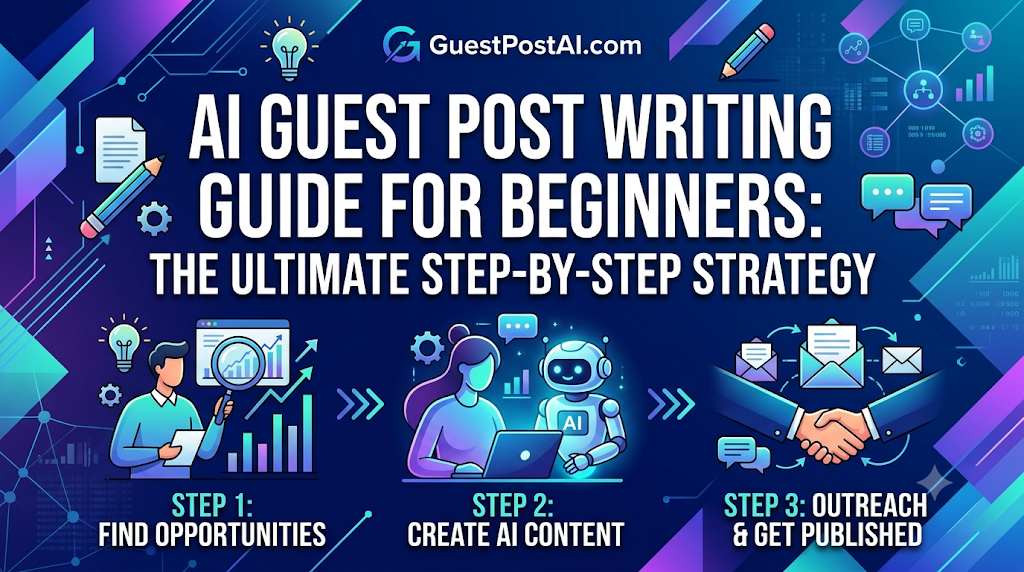
Welcome to the definitive AI Guest Post Writing Guide for Beginners. If you are looking to grow your online presence, build high-authority backlinks, and drive targeted organic traffic to your website, you have likely realized that content creation is one of the biggest bottlenecks in the process. This guide is specifically designed to show you how AI guest posting can streamline your workflows, dismantle creative blocks, and help you scale your digital footprint without sacrificing quality.
Historically, manual guest blogging required dozens of hours spent brainstorming, outlining, drafting, and editing. Today, AI guest post writing allows beginners to leverage advanced artificial intelligence to handle the heavy lifting of research and drafting. However, using artificial intelligence effectively requires a balanced approach. By blending AI efficiency with human creativity and strategic oversight, you can craft compelling pitches and articles that digital publishers are eager to host.
In this comprehensive guide, you will learn the exact step-by-step mechanics of using AI for guest posting for beginners. We will explore how to pick the right tools, execute flawless workflows, maintain strict editorial standards, and utilize GuestPostAI.com to automate your outreach and scale your success.
Foundations of AI Guest Posting
What Is AI Guest Post Writing?
AI guest post writing is the practice of utilizing generative artificial intelligence tools—such as Large Language Models (LLMs)—to assist in the creation of articles intended for publication on third-party websites. Instead of forcing you to stare at a blank page, AI tools act as collaborative partners. They help you conceptualize topics, build semantic structures, generate initial drafts, and optimize text for search engines based on specific data patterns.
Why Guest Posting Still Matters for SEO
Despite ongoing changes to search engine algorithms, SEO guest posting remains one of the most reliable pillars of modern digital marketing. Search engines rely heavily on signals of trust, authority, and relevance.
- Backlink Building: A contextual link from an established domain acts as a vote of confidence, signaling to search algorithms that your website is trustworthy.
- Referral Traffic: Publishing content on popular websites exposes your brand to an already engaged audience, filtering high-intent visitors directly to your pages.
- E-E-A-T Cultivation: Aligning your name or brand with respected publications establishes your Experience, Expertise, Authoritativeness, and Trustworthiness in your industry.
Benefits of Using AI for Guest Post Writing
For digital marketers, freelancers, and small business owners, AI-assisted content creation addresses the primary resource constraints of traditional link building:
- Drastic Time Savings: AI can generate a comprehensive 1,500-word outline and rough draft in minutes, reducing overall content production time by up to 70%.
- Overcoming Writer’s Block: AI provides instant variations of titles, introductions, and creative angles tailored to specific target audiences.
- Built-in SEO Synchronization: Many modern AI platforms natively integrate data structures to ensure your text hits essential semantic keyword densities naturally.
Limitations of AI and Why Human Editing Is Important
While AI tools are exceptionally powerful, they are not infallible. Beginners must understand that AI functions as an assistant, not an autonomous replacement for human writers.
- Lack of Real-World Experience: AI cannot invent personal anecdotes, proprietary case studies, or original experiments—the exact elements that search engines value under E-E-A-T guidelines.
- Risk of Hallucinations: AI models can confidently state incorrect facts, outdated statistics, or broken citations.
- Stylistic Monotony: Unedited AI outputs frequently feature repetitive sentence structures, predictable transitions, and a sterile, generic tone that web editors spot instantly.
Strategic and Ethical Foundations
How AI Fits Into a Beginner’s SEO Strategy
As a beginner, your primary constraint is typically time or budget. AI balances this equation. By integrating AI into your workflow, you can handle high-level research and rapid production without hiring expensive writing agencies. The goal is to use AI to build a strong operational foundation—generating variations of topics and drafts—while focusing your personal energy on strategy, relationships, and refinement.
Common Mistakes Beginners Make
When starting out with AI content writing, avoid these common pitfalls:
- Publishing Raw AI Outputs: Copying and pasting directly from an AI tool without editing is a fast track to rejection from top-tier blogs.
- Ignoring Publisher Guidelines: Every website has its own formatting rules, internal linking preferences, and structural quirks. Generic AI writing ignores these nuances.
- Keyword Stuffing via Prompts: Forcing AI to mention a specific keyword dozens of times destroys readability and invites search engine penalties.
Ethical AI Content Practices
Ethical AI usage centers around transparency and value creation. Your primary metric should always be: Does this piece of content genuinely help the reader? If your AI-generated article provides unique insights, solves a distinct problem, and is thoroughly checked for accuracy, it meets high-quality content standards. Never use AI to mass-produce low-tier spin-text or scraped content intended solely to manipulate search rankings.
Future of AI-Assisted Guest Posting
The digital marketing landscape is shifting away from generic informational articles toward hyper-personalized, data-driven commentary. In the future, successful guest posting will require deep integration of original datasets, expert interviews, and proprietary graphics. AI will continue to act as the primary operational engine, allowing creators to translate raw data and human perspectives into beautiful, highly optimized content at scale.
Best AI Tools for Guest Post Writing
To build a successful AI SEO writing engine, you must select the right tools for your specific objectives. Below is an analytical breakdown of the top platforms available today.
1. ChatGPT (OpenAI)
- Best Use Case: Ideation, detailed outlining, and generating conversational content drafts.
- Key Features: Highly customizable instructions, advanced reasoning capabilities, and customizable GPT workflows.
- Pros: Excellent contextual understanding, fast generation speeds, and highly adaptable to distinct tonal prompts.
- Limitations: Can sound overly clinical or repetitive if not guided by robust, iterative prompting.
- Beginner-Friendliness: Extremely high; uses a natural chat interface that requires zero technical knowledge.
2. Claude (Anthropic)
- Best Use Case: Writing deeply analytical, nuanced long-form content and refining draft tones.
- Key Features: Massive context windows, exceptional grasp of complex writing styles, and excellent self-editing capabilities.
- Pros: Produces outputs that feel remarkably human-written, handling logic and professional tones flawlessly.
- Limitations: Occasional strict safety guardrails; formatting can sometimes require manual adjustment.
- Beginner-Friendliness: High; responds brilliantly to natural language instructions without requiring overly complex formatting.
3. Gemini (Google)
- Best Use Case: Sourcing real-time information, analyzing live web search trends, and drafting introductory overviews.
- Key Features: Native integration with Google Search data, multi-modal capabilities, and rapid processing.
- Pros: Excellent access to highly current factual information and industry statistics.
- Limitations: Creative outputs can sometimes feel overly structured or generic compared to dedicated creative tools.
- Beginner-Friendliness: Very high; integrates cleanly if you are already comfortable inside the Google ecosystem.
4. Jasper
- Best Use Case: Scaling structured, brand-aligned marketing copy and distinct corporate blog articles.
- Key Features: Pre-built templates for blog frameworks, custom brand voice memories, and team workflow features.
- Pros: Significantly eliminates prompt engineering hurdles through curated interface structures.
- Limitations: Higher price tier; requires active subscription management to get full value.
- Beginner-Friendliness: Moderate to High; the extensive library of templates simplifies operations for new users.
5. Copy.ai
- Best Use Case: Streamlining automated content workflows, brainstorming headlines, and creating variants of outreach assets.
- Key Features: Advanced marketing OS automation workflows, intuitive template interfaces, and multi-language support.
- Pros: Superb for creating structured operational templates and rapid messaging experiments.
- Limitations: Long-form content sometimes requires stitching distinct modules together manually.
- Beginner-Friendliness: High; clean layout lowers the learning curve for absolute beginners.
6. Writesonic
- Best Use Case: Rapid production of SEO-optimized articles and long-form listicles directly from keyword data.
- Key Features: Sonic Editor (Google Docs style layout) and real-time integration with trending web queries.
- Pros: Generates full-length structured drafts very quickly with automated keyword insertions.
- Limitations: Outputs require careful manual fact-checking, as speed can occasionally compromise nuanced accuracy.
- Beginner-Friendliness: High; very structured, wizard-driven generation flows guide you step-by-step.
7. Surfer SEO
- Best Use Case: Auditing content, calculating real-time keyword densities, and optimizing existing articles for Google SERPs.
- Key Features: Live Content Editor optimization score, semantic NLP analysis, and competitor structural analysis.
- Pros: Provides an objective, data-backed roadmap telling you exactly what words to add to rank on Page 1.
- Limitations: Focuses strictly on statistical optimization; does not generate raw creative narrative out of the box without add-ons.
- Beginner-Friendliness: Moderate; the visual dashboard makes it easy to follow instructions, though learning SEO dynamics takes a bit of time.
8. Frase
- Best Use Case: Fast competitor research, building optimized content briefs, and structuring comprehensive article outlines.
- Key Features: Competitor SERP decompression matrix, automated heading generation, and integrated scoring modules.
- Pros: Saves hours of manual work by analyzing the top 20 ranking pages in a single click.
- Limitations: The writing interface can feel slightly rigid for users focused purely on creative prose.
- Beginner-Friendliness: Moderate; ideal for users who want to dive straight into the analytical side of SEO.
Core Methodology Comparison Tables
To help visualize how AI changes the content landscape, study the structural comparisons below.
Table 1: AI Writing vs. Manual Writing
| Operational Vector | AI-Assisted Writing | Traditional Manual Writing |
| Research Speed | Ultra-Fast (Seconds for outline curation) | Slow (Hours spent scrolling search results) |
| First-Draft Velocity | 3–5 minutes for 1,500 words | 2–4 hours for 1,500 words |
| Ideation Engine | Infinite thematic variations instantly | Dependent entirely on individual mental bandwidth |
| Error Vulnerability | Structural consistency; prone to factual hallucination | Typo-prone; highly resilient with logical truth |
| Unique Expert Value | Low out-of-the-box; requires human injections | High, rooted in individual human experiences |
Table 2: Free AI Tools vs. Paid AI Tools
| Capability Metric | Free Tier AI Engines | Paid Premium AI Frameworks |
| Model Access | Legacy foundational models | Cutting-edge LLM reasoning engines |
| Context Retention | Limited memory length across long documents | Massive data windows; retains full-article nuance |
| Live Web Access | Restricted or delayed web crawling | Live, real-time search indexing and scraping |
| SEO Suite Integrations | None; manual integration required | Direct programmatic alignment with live NLP platforms |
| Processing Limits | High throttling rates during peak hours | Dedicated high-priority access lanes |
Table 3: AI Draft vs. Human-Edited Draft
| Structural Quality | Raw AI Generation Output | Professionally Human-Edited Output |
| Tone & Cadence | Formulaic, repetitive transitions | Dynamic, engaging, and editorially sharp |
| Fact Alignment | Uncertain; requires validation | Fully validated with verifiable external links |
| E-E-A-T Signal | Completely absent generic summaries | High; full of real examples and proprietary case studies |
| Keyword Flow | Programmatic or overly sparse | Fluid; woven naturally into user-focused answers |
| Editor Approval | Frequently rejected by quality webmasters | Highly likely to be accepted and published |
Table 4: Beginner Workflow vs. Advanced Workflow
| Phase | Beginner Operational Blueprint | Advanced Enterprise Workflow |
| Keyword Selection | Basic manual entry into free tools | Intent-mapped clustering via automated platforms |
| Drafting Focus | Linear generation via single-sentence prompts | Iterative multi-stage component prompting |
| SEO Validation | Basic check for keyword inclusion | Multi-layered programmatic real-time NLP analysis |
| Outreach Model | Direct outreach to discovered blogs | Automated, multi-channel personalized PR campaigns |
Table 5: Common Problems vs. Recommended Solutions
| Observed Problem | Root Cause | Recommended Actionable Solution |
| Generic Voice | Vague, single-sentence prompts | Provide clear context, specific personas, and target audience details. |
| Factual Inaccuracy | AI guessing data points | Manually replace stats with verified links from authority sites. |
| Poor Formatting | Overuse of blocky text walls | Enforce strict markdown styling, bullet lists, and clear H3s. |
| High Bounce Rates | Boring introductory hooks | Re-write the introduction manually using an engaging narrative style. |
Step-by-Step AI Guest Post Writing Workflow
Follow this systematic blueprint to conceptualize, write, and polish your guest posts using AI tools efficiently.
Step 1: Choose a Niche
- Objective: Identify a clearly defined, monetizable vertical where your business carries genuine knowledge.
- Recommended AI Prompt:“Act as an expert SEO strategist. My core business focuses on [insert business topic, e.g., organic gardening tools]. Generate 5 complementary sub-niches suitable for a guest blogging campaign that share an audience overlap but do not directly compete with my core products.”
- Beginner Tips: Avoid picking massive categories like “Business” or “Health.” Narrow down to hyper-specific sub-niches like “Remote Team Onboarding” or “Keto Meal Prep for Beginners.”
- Common Mistakes: Selecting a niche that is completely disconnected from your brand, which ruins the SEO value of any backlinks you earn.
- Expected Outcome: A single, well-defined industry vertical with high audience relevance.
Step 2: Find Guest Posting Opportunities
- Objective: Identify high-authority websites within your niche that actively accept guest contributions.
- Recommended AI Prompt:“I am searching for websites within the [Niche Name] sector that accept external articles. Provide a list of 10 search strings I can use in Google search to surface write-for-us pages, submission guidelines, and editorial contacts tailored to this specific space.”
- Beginner Tips: Look for footprints like
“your niche” + “write for us”or“your niche” + “guest post guidelines”. - Common Mistakes: Pitching massive publications immediately without building up a portfolio on mid-tier blogs first.
- Expected Outcome: A curated list of 15–20 high-quality target URLs ready for outreach.
Step 3: Research the Target Website
- Objective: Deconstruct the target blog’s style, typical length, tone, and audience demographics.
- Recommended AI Prompt:“Here are three sample article titles and introductions from my target blog: [Paste samples]. Analyze the tone, reading grade level, typical sentence structure, and perspective (first person vs third person). Provide an operational style guide I can use to replicate this voice.”
- Beginner Tips: Read at least three of the target site’s most popular posts to understand what their audience loves to share.
- Common Mistakes: Sending an overly academic, dry article to a casual, fun website (or vice versa).
- Expected Outcome: A clear summary of the publisher’s editorial voice and content preferences.
Step 4: Perform Keyword Research
- Objective: Find high-intent, achievable keywords that the target site is not yet ranking for.
- Recommended AI Prompt:“For a target site in the [Niche] space, suggest 5 informational long-tail keywords that have clear user intent, could support a comprehensive guide, and naturally allow a contextual link back to a resource about [Your Topic Area].”
- Beginner Tips: Target low-competition informational terms (e.g., “how-to” keywords) rather than hyper-competitive commercial phrases.
- Common Mistakes: Choosing a keyword the target website has already written about extensively.
- Expected Outcome: One primary keyword and 3–5 supporting semantic terms.
Step 5: Create a Detailed Outline with AI
- Objective: Map out a highly logical, comprehensive heading hierarchy optimized for search engines.
- Recommended AI Prompt:[See the practical layout example below for the exact outline prompt formula]
Sample Prompt: Generating a Guest Post Outline
Plaintext
Act as a seasoned SEO content director. Create a comprehensive, long-form article outline for a guest post titled "The Ultimate Guide to Remote Team Onboarding for Startups". The primary target keyword is "remote team onboarding".

Incorporate the following structural elements:
- An introduction built to hook startup founders.
- At least 4 distinct H2 subheadings tracking the operational timeline.
- Deep H3 sub-points expanding on software tools, cultural integration, and metrics.
- A dedicated section addressing common remote pitfalls.
- A logical conclusion paving the way for a brand bio.

Ensure the outline maximizes semantic depth and follows logical pedagogy.
- Beginner Tips: Always review the outline before moving to the drafting stage. Make sure the headings flow naturally and answer real questions.
- Common Mistakes: Building a shallow outline that misses the core intent behind the user’s search query.
- Expected Outcome: A well-structured Markdown outline featuring clear H2 and H3 tags.
Step 6: Generate the First Draft
- Objective: Expand your finalized outline into a complete, clean, long-form text draft.
- Recommended AI Prompt:[See the practical layout example below for the exact introduction generation prompt formula]
Sample Prompt: Writing a Compelling Introduction
Plaintext
Using the outline we established, write the introductory section for the article. Use the PAS (Problem-Agitation-Solution) framework.

- Problem: The chaos and high turnover startups face due to unorganized onboarding.
- Agitation: The lost revenue, broken team morale, and wasted engineering hours.
- Solution: A systematic, automated remote onboarding framework.

Adopt a professional yet encouraging and authoritative tone. Do not use generic filler words like "In today's fast-paced digital world." Keep sentences dynamic and varied in length. Ensure the primary keyword "remote team onboarding" appears naturally within the first 100 words.
- Beginner Tips: Generate your content section by section rather than asking the AI to write all 2,000 words in a single prompt. This keeps the quality high and prevents the tool from rushing through details.
- Common Mistakes: Relying on basic prompts like “write a 1,000-word post about onboarding,” which produces generic, uninspired content.
- Expected Outcome: A raw text draft ranging from 1,500 to 2,000 words.
Step 7: Add Original Insights and Examples
- Objective: Inject authentic human experience, case studies, and unique value into the text.
- Recommended AI Prompt:“I want to insert a real-world example into the onboarding software section. Here is my raw personal experience: [Type out a brief, rough memory of how your business used a specific checklist to onboard an engineer in 48 hours]. Re-write this experience into a polished, engaging, professional short case study paragraph that fits smoothly into the text.”
- Beginner Tips: If you don’t have a personal story, quote an established industry expert or reference a well-documented public case study.
- Common Mistakes: Leaving the article as a collection of high-level concepts without any real-world proof points.
- Expected Outcome: A refined draft enhanced with authentic stories, metrics, and actionable value.
Step 8: Optimize for SEO
- Objective: Weave primary, secondary, and semantic terms into your text naturally.
- Recommended AI Prompt:[See the practical layout example below for the exact SEO optimization prompt formula]
Sample Prompt: SEO Optimization & Integration
Plaintext
Here is a draft section of my guest post: [Insert raw text draft section].

Review this text and intelligently integrate the following secondary semantic keywords naturally without stuffing:
- "virtual training workflows"
- "employee retention strategy"
- "digital onboarding documentation"

Make sure the flow remains conversational, professional, and readable. Bold the integrated keywords in the output so I can easily verify their placement.
- Beginner Tips: Prioritize writing for the human reader first. Ensure your keywords fit contextually and read smoothly out loud.
- Common Mistakes: Forcing keywords into sentences where they break the natural flow of conversation.
- Expected Outcome: A highly optimized draft with natural keyword placement and strong on-page signals.
Step 9: Edit and Proofread
- Objective: Clean up repetitive phrasing, correct grammatical errors, and polish your sentence structures.
- Recommended AI Prompt:“Review the following complete draft for stylistic flow and conciseness: [Insert full text]. Identify and fix any repetitive transitional phrases (e.g., ‘furthermore’, ‘in conclusion’, ‘it is important to note’). Shorten overly wordy sentences, ensure active voice dominates, and elevate the overall readability.”
Practical Example: Before-and-After AI Editing
Before Human/AI Refinement:
In today’s fast-paced digital business world, it is crucial and incredibly vital that companies look to implement remote team onboarding setups so that new workers are not feeling isolated. Furthermore, a failure to do this can result in employees quitting their jobs very quickly, which costs money.
After Strategic Refinement:
Poorly structured remote onboarding costs startups thousands in early employee turnover. When new hires spend their first week drowning in isolated, unorganized Slack channels, engagement drops. A systematic virtual workflow protects your hiring investment by connecting new employees with core team resources on day one.
- Pro Tip: Read the edited draft aloud. If you trip over a phrase or run out of breath, simplify the sentence structure.
- Expected Outcome: A publication-ready article that reads smoothly and holds the reader’s attention.
Step 10: Prepare the Author Bio and Links
- Objective: Create a professional author bio that builds credibility and contains your target backlink.
- Recommended AI Prompt:“Write a concise, authoritative 60-word professional author bio for [Your Name], Founder of [Your Company]. Highlight 10 years of experience in scaling operations. Include a natural call to action that links smoothly to [Your Website URL] using the anchor text ‘[Your Anchored Brand/Keyword]’. Make it sound natural and compelling.”
Practical Example: Sample Author Bio
John Doe is the lead operational strategist and founder of GrowthOps, a platform specializing in workspace optimization. With over a decade of hands-on experience scaling distributed engineering teams, John helps fast-growing companies optimize their remote workflows. Learn how to transform your workplace by exploring his team’s latest frameworks at [GrowthOps].
- Expected Outcome: A polished author bio and a professional, personalized outreach email tailored to your target publisher.
Plaintext
Subject: Content Idea for [Blog Name]: Modernizing Remote Onboarding

Hi [Editor Name],

I've been following [Blog Name]'s coverage of startup operations, especially your recent piece on distributed team culture. It got me thinking about the tactical hurdles founders face during their first week of hiring.

I've put together a comprehensive guide titled: "The Ultimate Guide to Remote Team Onboarding for Startups."

The article covers:
- The exact frameworks that cut early turnover by 40%.
- A blueprint for setting up virtual training workflows.
- Practical checklists that get engineers up to speed in 48 hours.

The post is fully optimized, formatted in clean Markdown, and focuses purely on actionable advice rather than promotional fluff.

Would you be open to reviewing the draft for your guest blog?

Best regards,
[Your Name]
[Your Website Link]
How to Write a Guest Post That Publishers Will Accept
Getting your content approved by busy editors requires a high level of quality. If your submission looks like a generic, automated text dump, it will be deleted immediately. Use these guidelines to ensure your content gets accepted:
- Match the Publisher’s Style perfectly: If the host blog uses brief, two-sentence paragraphs and a punchy, casual tone, format your post exactly the same way.
- Provide Unique Value from the start: Introduce data points, original graphics, or specific workflows that haven’t been covered a hundred times elsewhere on the web.
- Avoid Over-Promotion throughout the body: A guest post is an educational asset for the host’s audience, not a sales pitch for your product. Keep your contextual links relevant and educational, and save the direct brand call-to-action for your author bio.
- Use Credible Sources for validation: Back up every major claim or statistic with a link to high-authority, neutral platforms like research hubs, universities, or major industry studies.
- Format Correctly for the web: Deliver your articles in clean Markdown, using clear heading structures, short paragraphs, bold text for key insights, and bulleted lists for quick reading.
- Write Compelling Headlines that get clicks: Craft title variants that promise a clear benefit (e.g., “5 Onboarding Frameworks That Save Startups 20+ Hours a Week”).
AI Guest Post SEO Checklist
Before hitting the submit button, run your article through this foundational checklist to ensure it is fully optimized for search engines:
- [ ] Primary Keyword Placement: Embedded within the first 100 words of the introduction, naturally in at least one major H2, and smoothly inside the conclusion.
- [ ] Secondary Keywords: 3–5 related semantic terms woven naturally into subheadings and paragraph text.
- [ ] Meta Title: An engaging title under 60 characters that includes your primary keyword.
- [ ] Meta Description: A compelling summary between 150–160 characters designed to drive clicks from search results.
- [ ] Heading Structure: A clean, sequential hierarchy using
## H2and### H3tags without skipping levels. - [ ] Internal Linking Suggestions: 2–3 contextual links pointing back to existing relevant posts on the publisher’s own website.
- [ ] External Authority Links: 2–3 outbound links pointing toward highly trusted, non-competing educational resources.
- [ ] Readability Optimization: Paragraph blocks limited to a maximum of 3–4 sentences to keep the content highly scannable on mobile devices.
- [ ] Image Optimization: Clear, descriptive alt-text tags written for any charts or screenshots you include.
- [ ] Plagiarism Check: The complete text verified through premium detection platforms to ensure 100% originality.
- [ ] Final Proofreading: A final manual read-through to ensure all formatting is clean, smooth, and professional.
The GuestPostAI.com Advantage
How GuestPostAI.com Helps Beginners Succeed
While AI writing tools simplify the content creation process, managing an entire SEO campaign requires a lot of moving parts. This is where GuestPostAI.com comes in. The platform is designed specifically to help beginners organize, launch, and manage their guest posting campaigns in one central dashboard.
[Find Target Blogs] ➔ [Refine Content with AI] ➔ [Manage Outreach Pipelines] ➔ [Track Live Links]
- Finding Guest Posting Opportunities: The platform features intelligent filtering systems that help you instantly discover real, active blogs accepting guest writers within your niche.
- AI-Assisted Content Workflows: It offers dedicated, step-by-step writing workspaces built specifically for guest blogging, ensuring your drafts match high editorial standards automatically.
- Outreach Support: Streamline your communication with pre-tested email pitch templates that capture the attention of busy blog editors.
Why Beginners Choose GuestPostAI.com
- All-in-One Simplicity: Eliminates the need to juggle disjointed spreadsheets, separate email tools, and standalone AI writing apps.
- Time-Saving Workflows: Cuts down your manual research time, letting you focus on building relationships and refining your content strategy.
- Long-Term SEO Benefits: By combining structured AI content workflows with efficient outreach tools, beginners can consistently earn the high-quality links needed to grow their organic traffic.
30-Day AI Guest Posting Action Plan for Beginners
Use this organized 4-week timeline to take your campaign from an idea to live, published content.
Week 1: Research and Setup
- Day 1–3: Define your target sub-niche. Use AI tools to map out a clear list of target keywords.
- Day 4–7: Identify 15 high-quality blogs accepting guest contributions. Analyze their submission guidelines and organize your contacts inside GuestPostAI.com.
Week 2: Content Creation
- Day 8–10: Pick your top 3 guest post concepts. Use AI tools to generate highly structured, logical outlines for each topic.
- Day 11–14: Expand those outlines into complete, detailed first drafts using iterative, section-by-section prompting.
Week 3: Editing and Optimization
- Day 15–17: Review your drafts. Manually inject your own personal insights, real-world examples, and verified statistics.
- Day 18–21: Run through the AI Guest Post SEO Checklist. Refine your heading structures, check your keyword usage, and format the text in clean Markdown.
Week 4: Outreach and Tracking
- Day 22–25: Personalize your email pitches and reach out to your targeted website editors.
- Day 26–30: Follow up politely on pending submissions, deliver your finalized content files, and track your new live backlinks as they are published.
Frequently Asked Questions (FAQs)
1. Can I use AI to write guest posts?
Yes, you can absolutely use AI to assist with your guest post writing. The key is using it as an editing and drafting partner rather than simply copying and pasting raw text. Successful guest posting requires human oversight to ensure the content is accurate, engaging, and aligned with the host blog’s editorial guidelines.
2. Does Google penalize AI-generated content?
Google’s official guidelines state that they reward high-quality, helpful content, regardless of how it is produced. They focus on the value the content provides to the reader. However, mass-producing low-effort, unedited AI content solely to manipulate search rankings can lead to penalties under their spam policies.
3. How do I make my AI content look human-written?
To give your AI content a natural, human touch, edit out repetitive phrases and vary your sentence lengths. Most importantly, add elements that AI cannot create on its own: personal anecdotes, real case studies, proprietary business data, and unique expert commentary.
4. What are the best free AI tools for beginners?
The standard free versions of ChatGPT, Claude, and Gemini are fantastic starting points for beginners. They provide excellent support for brainstorming topics, organizing outlines, and polishing individual paragraphs without requiring any upfront costs.
5. How do I find blogs that accept guest posts?
You can find opportunities by using targeted Google search footprints like “niche keyword” + “write for us”. For a much faster, more organized approach, you can use specialized platforms like GuestPostAI.com to instantly scan and filter active websites that welcome guest authors.
6. What should I include in an outreach pitch?
Keep your pitch email brief, friendly, and highly personalized. Address the editor by name, mention a specific article you enjoyed on their site, and offer 2–3 distinct topic ideas that provide clear value to their readers.
7. How long should a guest post be?
Most authoritative blogs prefer articles between 1,200 and 2,500 words. Longer, comprehensive guides tend to perform better in search engine rankings and offer more opportunities to weave in helpful semantic information naturally.
8. What is an author bio, and why is it important?
An author bio is a short paragraph at the end of a guest post that introduces you and your business. It is a vital part of your strategy because it establishes your professional credibility and hosts the contextual backlink that points readers and search crawlers back to your website.
9. How many backlinks should I include in a single guest post?
As a general rule, aim for 1 contextual backlink to your own website within the main body of the article (if the publisher’s rules allow it) and 1 link inside your author bio. Balance this out by including 2–3 internal links to the host website’s own articles and 2 links to high-authority external reference sites.
10. How long does it take to see SEO results from guest blogging?
Earning high-quality backlinks typically yields visible SEO improvements within 4 to 12 weeks. The exact timing depends on how quickly search engines crawl the host site, the existing authority of the domain, and the overall competitiveness of your target keywords.
11. What is the difference between guest posting and link building?
Guest posting is a highly effective method within the broader world of link building. While link building includes a variety of strategies (like fixing broken links or unlinked brand mentions), guest posting focuses on earning links by providing full, high-quality articles to partner websites.
12. Can beginners use GuestPostAI.com without advanced SEO knowledge?
Absolutely. GuestPostAI.com is built with beginners in mind. The platform simplifies the entire process by guiding you through discovering target blogs, developing content, and managing your outreach campaigns within an intuitive, user-friendly interface.
13. How do I handle editors who ask for content revisions?
View revision requests as a great sign that the editor is interested in your work. Use your AI tools to quickly address their structural notes, update any sections they highlight, and return the polished draft promptly to show you are a reliable partner.
Conclusion
Mastering the mechanics of AI guest post writing is one of the most effective ways for beginners to scale their SEO results, build high-value backlinks, and grow organic traffic. By using advanced artificial intelligence tools to handle research and initial drafting, you can save hours of manual work and overcome creative roadblocks easily.
However, always remember that the secret to long-term success lies in the balance between human creativity and technology. Never publish raw, unedited AI content. Take the time to inject your own real-world experiences, fact-check every statistic, and optimize your articles according to our AI Guest Post Writing Guide for Beginners framework.