Introduction
In search engine optimization, visibility is not an accident; it is earned through authority. Every second, search engines process hundreds of thousands of queries, deciding which websites deserve a spot on the first page and which will fade into obscurity. If your content is excellent but your website lacks structural trust, your pages will struggle to climb the organic search rankings.
To stand out, modern digital marketers, SEO agencies, and SaaS founders must master a central pillar of off-page optimization: learning how to build domain authority. While Google uses multiple signals to rank a web page, the structural equity passed through an authoritative, diverse, and clean backlink profile remains a dominant ranking factor.
Among the various strategies used to acquire these links, guest posting for SEO stands out as an exceptionally reliable, ethical, and powerful approach. This article will show you how targeted guest blogging drives domain authority growth, builds real-life business credibility, and establishes long-term search engine visibility.
What Is Domain Authority?
Domain Authority (DA) is a logarithmic score originally created by Moz that predicts a website’s likelihood of ranking on search engine results pages (SERPs). Scores range from 1 to 100, with higher numbers indicating a stronger capability to rank. Other leading tools use similar metrics, such as Ahrefs’ Domain Rating (DR) and Semrush’s Authority Score (AS).
While third-party authority scores are comparative tools rather than direct, internal Google metrics, they act as an accurate reflection of a site’s link profile strength. A domain’s score rises as it earns more editorial validation from trusted web properties.
Why Domain Authority Matters for SEO
A high authority score means your domain has earned deep structural trust with search engines. This offers several key advantages:
- Faster Indexing of New Pages: Google crawlers prioritize high-authority sites, discovering and indexing new articles much faster.
- Lower Content Investment Barriers: Authoritative sites can rank for competitive mid-tail keywords almost immediately, whereas newer sites must spend months building foundational signals for those same terms.
- Resistance to Algorithm Shakes: Sites with natural, high-authority backlink profiles handle core algorithm updates much better than sites relying on low-tier links.
How Search Engines Evaluate Website Authority
Search engines use automated ranking algorithms to assess the authority of an entity or domain. While original systems relied on basic link counts, modern search intelligence focuses heavily on Google’s E-E-A-T framework: Experience, Expertise, Authoritativeness, and Trustworthiness.
Google Authority Assessment
 ├── Backlink Quality & Link Equity (PageRank)
 ├── Topical Relevance (Niche alignment between entities)
 └── Brand Trust Signals (Real brand footprints, high editorial standards)
To evaluate website authority, modern search crawlers analyze:
- Link Equity Context: Outbound links from trusted newsrooms, academic spaces, or established industry sites carry heavy weight.
- Topical Neighborhoods: Search engines look at whether the linking site is topically related to the receiving site. For example, a link from an engineering firm to a construction software vendor provides high topical authority.
- Link Distribution Patterns: A healthy domain features links spread naturally across homepages, internal resources, and deep informational assets.
The Relationship Between Backlinks and Domain Authority
To grow your website’s authority, you must focus on building a strong link profile. Think of a backlink as an editorial vote of confidence. When an external domain links to your content, it passes a share of its own authority—often called “link juice” or link equity—to your site.
Earning fifty links from fifty separate, high-quality, unique domains will build much more authority than acquiring fifty links from a single external site. Additionally, links placed naturally within the body text of an article pass significantly more value than automated, boilerplate links hidden in footers or sidebars.
What Is Guest Posting?
Guest posting—or guest blogging—is an off-page SEO strategy where you write an original, high-value article for an external website in exchange for a natural, contextual link back to your own domain.
Far from being a simple outreach tactic, professional guest posting is an asset-sharing partnership. The host publisher receives free, well-researched content that engages their readers, while your brand secures an editorial backlink that strengthens your search visibility.
Why Guest Posting Remains a Premier Link-Building Strategy
While digital PR and broken link building are useful tactics, guest blogging remains highly popular among SEO professionals because it gives you direct control over your link context.
Industry data highlights the value of this strategy:
- Over 65% of SEO professionals state that manual link acquisition is the single hardest part of search optimization.
- Studies show that content-focused outreach campaigns deliver a much higher conversion rate than generic cold outreach.
- According to multi-industry analysis, brands running structured guest blogging campaigns report an average organic traffic increase of over 200% within a year.
How Guest Posting Strengthens Domain Authority
Let’s break down the exact mechanics of how a planned guest blogging campaign helps you build domain authority.
Earning Quality Backlinks
- How it works: You place a thoroughly researched, helpful article on a top-tier host site that features an inline, contextual link pointing back to your site.
- SEO benefits: Passes clean PageRank directly to your landing pages, which raises your core authority scores.
- Long-term impact: Gradually increases your site’s baseline authority, helping your entire content library rank higher.
Building Niche Relevance
- How it works: By guest posting consistently on sites in your vertical, you show search engines that your business belongs in that specific industry ecosystem.
- SEO benefits: Strengthens your topical authority, making it easier to rank for competitive primary search phrases.
- Long-term impact: Protects your search rankings from core algorithm updates by cementing your brand as a trusted niche authority.
Increasing Trust Signals
- How it works: Publishing your insights on strict, editorially managed domains associates your business with established market leaders.
- SEO benefits: Satisfies Google’s E-E-A-T criteria by showing a real, validated brand footprint across the web.
- Long-term impact: Lowers your domain’s spam score and improves your brand’s overall digital credibility.
Improving Search Visibility
- How it works: As your guest articles begin to rank on your host websites, they direct high-intent referral traffic back to your own site.
- SEO benefits: Signals to search engines that real users are actively seeking out your brand.
- Long-term impact: Diversifies your traffic sources, protecting your business from relying entirely on a single search channel.
Expanding Audience Reach
- How it works: Your brand is introduced directly to the host site’s existing community of active readers.
- SEO benefits: Increases direct type-in navigation traffic and branded search volume.
- Long-term impact: Converts cold search impressions into a community of loyal brand advocates.
Strengthening Brand Authority
- How it works: Writing comprehensive guides on high-traffic sites establishes your team as true industry experts.
- SEO benefits: Earns your business natural, unearned brand mentions and secondary links from other creators.
- Long-term impact: Positions your business as a top-of-mind leader in your field, driving organic B2B or B2C conversions.
Characteristics of High-Quality Guest Posting Opportunities
Not all guest opportunities are created equal. To protect your brand and get the best results, evaluate potential publishers against these six criteria:
- Domain Relevance: The host site must focus on your niche or feature a highly relevant, active subcategory.
- Real Organic Traffic: Use tools like Semrush or Ahrefs to confirm the site has a steady stream of real human traffic. Avoid sites with high authority metrics but zero actual organic visitors.
- High Content Quality: The site should feature well-formatted, original articles written by real humans. Avoid sites that publish low-grade, generic AI text.
- Active Audience Engagement: Look for signs of life, such as real comments, social shares, and active community discussions.
- Strict Editorial Standards: If a site accepts every pitch instantly without reviewing the copy, search engine algorithms will likely devalue its outbound links. Target sites that maintain strict editorial guidelines.
- Natural Link Placement: Ensure your links are placed naturally within the main body of the article, surrounded by contextually relevant text.
Deep Structural Comparisons: Link Building Analysis
To optimize your marketing investments, look at these detailed data breakdowns comparing different authority-building methods.
Table 1: Guest Posting vs Other Link Building Strategies
| Strategy | Control Over Anchor Text | Topical Relevance | Scalability | Cost & Effort Barrier |
| Guest Posting | High | Very High | High | Moderate (Requires Workflow) |
| Digital PR | Low | Broad / General | Variable | High |
| Broken Link Building | Moderate | Moderate | Low | High |
| Directory Submissions | High | Very Low | High | Low (Low Value) |
| Resource Page Pitching | Moderate | High | Moderate | Moderate |
Table 2: High-Quality vs Low-Quality Backlinks
| Feature | High-Quality Backlink | Low-Quality Backlink |
| Source Domain Status | Active site with real, steady traffic | Private Blog Network (PBN) or link farm |
| Editorial Standards | Manual review and clear writing rules | Automated approvals; zero content filtering |
| Link Contextualization | Placed naturally within long-form body text | Isolated in footers, sidebars, or link lists |
| Outbound Link Quality | Links out exclusively to trusted resources | Links out to spammy, unrelated niches |
| SEO Impact | Long-term domain authority growth | Risk of search penalties and algorithmic drops |
Table 3: White-Hat vs Black-Hat Link Building
| Evaluation Dimension | White-Hat SEO (Strategic Guest Posting) | Black-Hat SEO (Manipulative Tactics) |
| Value Provided | Helpful, original content written for humans | Low-grade, spun, or scraped text |
| Risk Profile | Completely safe; insulated from algorithm updates | High risk of manual actions and de-indexing |
| Sustainability | Builds long-term brand value and authority | Short-lived spikes followed by rank drops |
| Relationship Quality | Develops real, lasting industry partnerships | Solely transactional and often hidden |
Table 4: Authority Building Methods Comparison
| Method | Target Metric Impact | Operational Turnaround | Implementation Safety |
| Guest Blogging | Balanced DR/DA + Topical Trust | 1 – 3 Weeks | High (Safe and Compliant) |
| Organic Link Baits | Page-Specific Authority | Variable (Unpredictable) | High |
| Media Outreach | Broad Domain Authority | Weeks to Months | High |
| Paid Link Networks | Artificially Raised Scores | 24 – 48 Hours | Very Low (High Risk) |
Table 5: Domain Authority Growth Factors
| Growth Variable | Impact Weight | Strategic Priority | Primary Action Item |
| Referring Domain Diversity | Critical | High | Target new sites instead of repeating past ones |
| Contextual Placement | High | High | Embed links within deep body text sections |
| Anchor Text Mix | Moderate | Balanced | Mix branded, natural, and partial keyword phrases |
| Host Site Traffic Status | High | High | Filter out sites with declining organic traffic |
Common Domain Authority Myths & Low-Quality Risks
The Numbers Chase Myth
Many marketers think that hitting an arbitrary DA number is all that matters. In reality, a DA 40 site with high topical relevance and steady organic traffic often passes more real value than a DA 70 multi-topic blog that sells links to anyone.
The “All Links Are Equal” Misconception
A link hidden away in an unindexed author biography carries almost zero algorithmic value compared to an inline contextual link integrated into the core discussion of an article.
Risks of Low-Quality Networks
Buying cheap guest posts from automated marketplaces often places your links on unmoderated websites. Google’s modern spam detection systems are designed to identify and ignore unnatural link patterns, meaning poor-quality outreach wastes your budget and can put your site’s safety at risk.
The Future of Guest Posting and Authority Building
As search engines rely more heavily on machine learning and entities to understand the web, the future of link building belongs entirely to high-quality content.
Search crawlers are becoming incredibly skilled at identifying and ignoring low-effort guest posts written solely for links. To remain effective, future campaigns must focus on creating comprehensive, expert-level articles that provide real value to readers. High editorial standards, genuine author profiles, and contextual relevance are the keys to long-term SEO success.
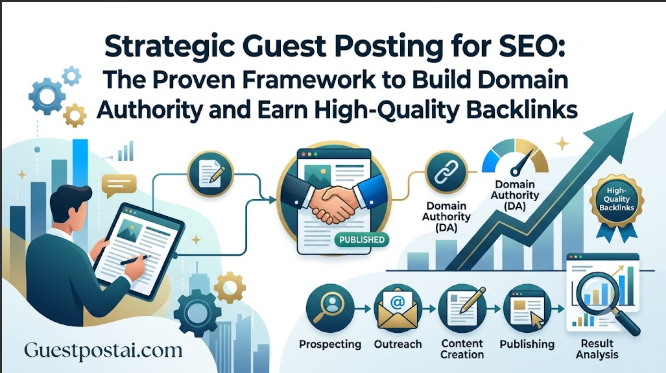
Step-by-Step Guest Posting Strategy for Building Domain Authority
1. Set Clear SEO Objectives
Define your goals before launching your campaign. Identify the specific pages on your site that need an authority boost, review your current link profile metrics, and decide on the target anchor text ratios needed to keep your profile looking natural.
2. Find Quality Target Websites
Locate potential publishers using targeted Google search operators, such as:
"your industry" + "write for us""niche keyword" + "guest post guidelines""industry sector" + "contributing writer"
3. Evaluate Domain Relevance and Health
Check each potential site using your preferred SEO tool. Look for steady, long-term organic traffic trends and verify that the site is properly indexed by Google.
4. Create Valuable Content
Write an in-depth, well-structured article that genuinely addresses the target audience’s questions. Use proper formatting, break up text with subheadings, and include practical data or examples.
5. Pitch and Build Real Relationships
Send a personalized, concise pitch to the site’s editor. Reference their recent content, clearly explain why your topic fits their audience, and share links to your previously published writing to prove your expertise.
6. Secure and Verify Placements
Once your article is live, check the source code to verify your link is correctly formatted as dofollow and that the page is accessible to search engine crawlers.
7. Monitor Your Authority Growth
Track your link building results over time. Watch for changes in your overall domain scores, increases in organic traffic, and ranking improvements for your primary target keywords.
Domain Authority Growth Checklist
Review this checklist before launching any guest blogging campaign to ensure every link delivers the maximum return on your investment:
- [ ] Traffic Status: Has the target domain shown steady, real organic traffic over the past 12 months?
- [ ] Topical Fit: Is the host site genuinely related to your industry or target niche?
- [ ] Indexing Status: Are the site’s recently published posts showing up properly in Google search results?
- [ ] Link Integrity: Will your link be placed contextually within the main body text?
- [ ] Editorial Standards: Does the publisher enforce strict writing and quality guidelines?
- [ ] Link Profile Balance: Are you targeting a diverse mix of new referring domains?
- [ ] Anchor Text Safety: Is your anchor text written naturally, avoiding keyword stuffing?
- [ ] Workflow Automation: Are you using specialized platforms like GuestPostAI.com to scale your outreach safely?
How GuestPostAI.com Simplifies Authority-Focused Guest Posting
Running a manual guest posting campaign requires a huge amount of manual effort—from hunting down contact details to handling endless email threads and managing content creation.
GUESTPOSTAI.COM solves this problem by providing an all-in-one platform built to help businesses build domain authority cleanly and efficiently.
[Your Domain Goals] ──► [GuestPostAI Platform] ──► [Vetted Publishers] ──► [High-Equity Placements]
Smart Opportunity Discovery
GuestPostAI.com eliminates manual guesswork by matching your site with high-quality, pre-vetted publishers in your exact niche. Every site in the network is verified for real organic traffic, clean link profiles, and authentic search engine visibility.
Streamlined Outreach Management
The platform handles the time-consuming outreach work for you, replacing messy spreadsheets with a central dashboard where you can easily plan, track, and manage your entire link building strategy.
AI-Assisted Content Production
By pairing advanced writing tools with human editorial standards, the platform produces highly relevant, search-optimized articles that meet the strict requirements of top-tier publishers, ensuring high placement success rates.
Why Businesses Choose GuestPostAI.com for SEO Growth
- Operational Efficiency: Saves your marketing team hours of manual prospecting and cold outreach work.
- Guaranteed Link Quality: Protects your site from low-quality link networks by focusing entirely on real, traffic-driving domains.
- Predictable Scaling: Allows you to scale your link-building campaigns smoothly, whether you’re growing a single startup or managing dozens of client websites.
- SEO-Focused Strategies: Helps you build clean, white-hat links that protect your business from algorithm updates while steadily growing your long-term organic search rankings.
Frequently Asked Questions (FAQs)
How long does it take to see domain authority growth from guest posting?
Search engine crawlers typically discover and index new backlinks within 2 to 4 weeks. You can generally expect to see a noticeable lift in your third-party authority metrics and organic search rankings within 60 to 90 days of running a consistent campaign.
Are guest post backlinks safe for white-hat SEO?
Yes, absolutely. Publishing original, high-quality content on real, editorially managed websites is a completely safe and encouraged white-hat SEO strategy. It only becomes a risk if you use automated software to blast low-quality, spun content across spammy link directories.
Should I focus more on a site’s DA score or its topical relevance?
Topical relevance should always come first. A contextual link from a highly relevant DA 35 industry blog sends much clearer quality signals to Google than a generic link on a DA 70 multi-topic site that publishes unrelated content.
What is the difference between dofollow and nofollow links?
dofollow links tell search engine crawlers to pass authority and link equity directly to your URL, helping improve your rankings. nofollow links (along with tags like rel="sponsored") indicate that the link shouldn’t pass ranking equity directly, though they can still send valuable referral traffic and brand visibility your way.
How many guest posts do I need to rank on the first page of Google?
There is no magic number. It depends entirely on how competitive your target keywords are and how strong your competitors’ link profiles look. A smart strategy focuses on a steady, natural pace of high-quality links rather than chasing a raw total.
Can I publish the same guest post on multiple websites?
No, every piece of content you submit must be completely original. Publishing duplicate copy across different domains can cause search engines to filter out the pages, damaging your organic visibility and your relationships with publishers.
How does GuestPostAI.com screen its publishing partners?
GuestPostAI.com uses strict quality checks to audit every publisher. The platform looks closely at historical traffic trends, indexation health, spam scores, and editorial standards to ensure your links land on genuine, reputable sites.
What is the safest anchor text strategy for building domain authority?
Keep your anchor text profile looking natural. Use a balanced mix of branded terms (your company name), partial-match keywords, plain URLs, and natural phrase anchors to keep your link profile healthy and safe from over-optimization filters.
Can guest blogging help my business if I am in a highly specific B2B niche?
Yes, it is often even more effective in specialized niches. Earning links from focused industry blogs signals deep topical authority to search engines, making it much easier to dominate search results for specific B2B queries.
How do I track if a guest post has successfully passed authority to my site?
Monitor your site’s link profile using tools like Ahrefs, Semrush, or Moz to confirm when the new link is discovered. Pair this with Google Search Console to track ranking improvements and organic impression growth on your linked target pages.
Conclusion
Learning how to build domain authority is a long-term commitment that requires a focus on quality, consistency, and genuine content value. While shortcuts like cheap link packages pose a serious threat to your site’s safety, strategic guest blogging stands out as a safe, time-tested way to earn high-quality backlinks and build lasting trust with search engines.
By sharing your expertise with relevant, authoritative audiences, you build a strong foundation for sustainable growth. Platforms like GuestPostAI.com make this entire process simple, giving you the tools to manage and scale your campaigns safely and predictably.
Take control of your search visibility today. Choose your target niches, focus on delivering exceptional content value, and watch your website authority and organic traffic scale steadily over time.