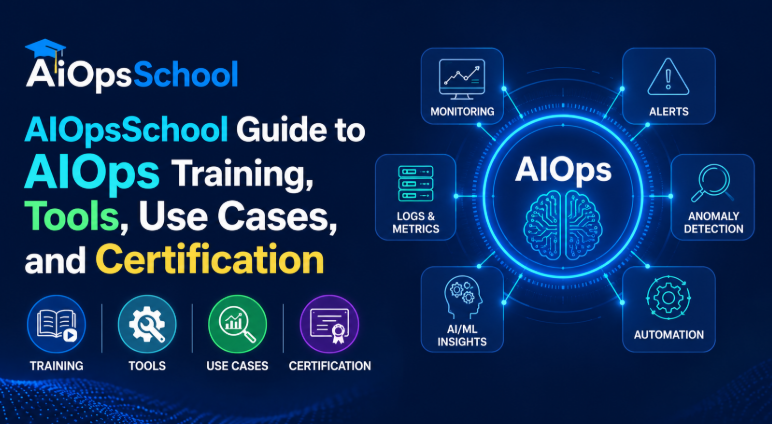
Modern enterprise infrastructure moves faster than human eyes can track. On any given day, operations teams handle millions of metrics, logs, and traces flowing across distributed cloud-native architecture. When a critical dependency fails, it triggers an avalanche of downstream alerts, causing severe alert fatigue and leaving engineers drowning in operational noise while scrambling to locate the root cause. As systems grow increasingly complex, legacy monitoring tools that rely on static, manually configured thresholds simply cannot keep pace with these scale-out environments.
To break out of this reactive cycle of fire-fighting, forward-thinking organizations are transitioning away from manual oversight and moving toward intelligent, data-driven automation. This shift requires a deep understanding of how machine learning intersects with telemetry data—a skill set that is currently in incredibly high demand. To bridge this critical knowledge gap, professionals are investing in structured AIOps Training to master the methodologies required to run self-healing, highly resilient digital platforms. Exploring educational frameworks through AiOpsSchool helps teams and individuals build these exact competencies, ensuring they can successfully navigate the complexities of modern, scale-out enterprise architecture.
Defining the Modern Paradigm: What Is AIOps?
The term AIOps, which stands for Artificial Intelligence for IT Operations, represents the strategic application of machine learning, data science, and natural language processing to the operational domain. To truly understand What is AIOps, one must look at it not as a single software application, but as an architectural practice. It functions by continuously ingesting massive volumes of telemetry data from every layer of the technology stack, neutralizing data silos, and extracting actionable patterns in real time.
In large-scale environments, traditional human analysis fails because the sheer volume and velocity of data surpass human cognitive limits. Machine learning models excel here because they establish dynamic baselines of what constitutes “normal” system behavior across thousands of interconnected microservices. Instead of waiting for a hard threshold to break, an intelligent operational system detects subtle mathematical deviations across multiple metrics simultaneously. This mathematical approach allows infrastructure teams to surface latent anomalies before they degrade the end-user experience, moving IT operations away from manual triage and toward automated, algorithmic interpretation.
Key Operational Concepts You Must Know
Navigating the landscape of modern AIOps in IT operations requires absolute clarity on a few foundational technical concepts. These terms form the building blocks of intelligent infrastructure management, and understanding how they interlock is essential for any technical professional.
Telemetry and Observability
- Observability: The measure of how well you can infer the internal states of a system based entirely on its external outputs. It moves beyond simple monitoring by focusing on system context.
- Telemetry: The raw data points collected from an environment. This raw data is universally categorized into three distinct pillars:
- Logs: Time-stamped text records of discrete events that occurred within an application or operating system.
- Metrics: Numeric values measured over intervals of time, used to track resource consumption like CPU utilization or request latency.
- Traces: End-to-end journeys of a single request as it travels through a distributed web of microservices.
Data Analysis and Behavioral Baseline
- Event Correlation: The process of analyzing thousands of disparate log lines and alerts across different systems to identify which events belong to the exact same underlying incident.
- Baselines: Dynamically calculated ranges of normal performance that automatically adapt to seasonal business cycles, such as higher traffic on Friday afternoons.
- Anomalies: Data points or patterns that deviate significantly from the established baseline, indicating potential underlying issues.
Execution and Continuous Improvement
- Automation: The execution of predictable, scripted tasks without requiring human intervention, reducing manual toil.
- Remediation: The specific corrective action taken to resolve an IT incident, which can range from restarting a container to automatically provisioning additional cloud storage.
Getting Started with AIOps
For engineers and administrators looking at AIOps for beginners, the initial learning curve can feel intimidating due to the intersection of data science and systems engineering. However, the market demand for these specialized skills is growing exponentially as enterprise architectures become too massive for humans to govern manually.
[Legacy Monitoring] ---> [Observability Ingestion] ---> [Algorithmic Correlation] ---> [Automated Remediation]
Aspiring professionals must focus on how data collection feeds into automated decision-making engines. Understanding this pipeline is the first step toward shifting from a traditional administrator role to an intelligent automation specialist. Three primary drivers are currently accelerating the global adoption of these automated methodologies:
- Career Opportunities: Organizations are aggressively hunting for infrastructure engineers who possess a deep understanding of data analytics, leading to high-paying, future-proof roles across enterprise tech.
- Technology Trends: The explosive rise of ephemeral, multi-cloud architectures and Kubernetes clusters has made manual system configuration completely obsolete.
- Industry Adoption: Top-tier enterprise companies across finance, healthcare, and retail are actively mandating intelligent automation strategies to preserve their strict service level agreements.
Distinguishing Key Methodologies: AIOps vs DevOps vs MLOps
As IT paradigms evolve, it is common to see overlapping terminology cause confusion in engineering organizations. To build an efficient operational strategy, professionals must clearly delineate the practical differences and specific focus areas of AIOps vs DevOps and AIOps vs MLOps. While they all leverage automation, they serve completely different phases of the technology lifecycle.
| Concept | Primary Focus | Core Question It Answers |
| DevOps | Software delivery velocity, CI/CD pipelines, and breaking down organizational silos between developers and operations teams. | How can we safely deploy high-quality software changes to production as quickly as possible? |
| AIOps | Production system resilience, intelligent event correlation, and automated incident response using machine learning. | How can we use algorithmic insights to keep complex, live production environments stable and highly available? |
| MLOps | Standardizing the lifecycle of machine learning models, managing training datasets, and tracking model deployment drift. | How do we reliably build, test, deploy, and monitor machine learning models in production environments? |
While DevOps focuses heavily on the cultural and systemic workflow of shipping code, intelligent operations steps in once that code is live. It analyzes the runtime environment continuously. On the other hand, MLOps treats the machine learning model itself as the software artifact that needs deploying. Interestingly, these fields frequently overlap: an enterprise might utilize MLOps workflows to train and deploy a custom anomaly detection model that is explicitly used within their production operations platform.
Platform Implementation vs Culture Change
A very common and expensive mistake made by enterprise leadership is treating intelligent operations purely as a software purchase. Buying an advanced platform and turning it on will not magically fix an unstable architecture. True success requires deep process maturity, intentional organizational change, and explicit AIOps Training for the humans who interact with these platforms daily.
Teams must explicitly build trust in algorithmic automation over time. If engineers do not trust the platform’s insights, they will simply ignore the automated recommendations and continue troubleshooting manually, entirely defeating the purpose of the technology. Operational discipline must be maintained during this transition; telemetry data must be kept clean, and teams must collaborate closely to define exactly what tasks can be safely offloaded to automated systems. Ultimately, modifying cultural habits and workflows is what allows an organization to successfully scale AIOps in IT operations.
Core AIOps Use Cases
Deploying intelligent algorithms into production unlocks several critical capabilities that drastically optimize day-to-day infrastructure management. Below are the primary AIOps use cases driving modern operational transformations.
1. Anomaly Detection
- The Challenge: Traditional monitoring uses static alerts (e.g., alert if CPU exceeds 85%). This causes false alarms during intentional batch jobs or misses real issues when a service hangs at 40% CPU but stops processing requests entirely.
- How Algorithmic Systems Help: Mathematical models evaluate multiple dimensions of telemetry data concurrently, detecting statistical deviations from historical norms without relying on rigid thresholds.
- Practical Example: A payment gateway detects a subtle, 4% drop in transactions executed from a specific geographic region, flagging an underlying regional ISP routing problem long before any standard ping test fails.
2. Event Correlation and Noise Reduction
- The Challenge: A single network switch failure can cause five hundred virtual machines to throw individual connectivity alerts simultaneously, creating a massive wave of noise that hides the root problem.
- How Algorithmic Systems Help: The system automatically groups thousands of related notifications occurring across a specific time window and topology into a single, cohesive incident ticket.
- Practical Example: An operations center receives a single, consolidated alert stating that a localized rack power loss occurred, automatically suppressing five hundred secondary alerts from downstream web servers.
3. AIOps Root Cause Analysis
- The Challenge: Finding the exact line of code or infrastructure change that caused a multi-service outage usually requires hours of manual log digging across multiple distinct engineering teams.
- How Algorithmic Systems Help: By mapping the entire system topology and correlating telemetry data with recent CI/CD code deployments, AIOps root cause analysis instantly highlights the exact change that triggered the failure.
- Practical Example: Following a major application slowdown, the analytics engine instantly points engineers to a specific database schema update that was deployed precisely ninety seconds before performance began degrading.
[Telemetry Ingestion]
         │
         ▼
[Anomaly Detected] ───► [Topology Mapping] ───► [Deployment Log Cross-Reference]
                                                          │
                                                          ▼
                                             [Root Cause Identified]
4. Predictive Capacity Planning
- The Challenge: IT environments frequently run out of storage or computing power unexpectedly due to unpredicted, non-linear growth patterns in application usage.
- How Algorithmic Systems Help: Linear and non-linear regression algorithms analyze historical utilization trends to accurately predict exactly when a resource will reach its physical limitations.
- Practical Example: A cloud architecture platform calculates storage growth trends and notifies the infrastructure team that an object storage volume will hit maximum capacity in exactly fourteen days, allowing for a relaxed, scheduled upgrade.
5. Automated Remediation
- The Challenge: Human engineers are frequently woken up at 3:00 AM to perform simple, repetitive operational tasks like clearing disk space or restarting frozen application pools.
- How Algorithmic Systems Help: The platform matches a high-confidence root cause identification with a validated, secure automation script to safely fix the issue without human intervention.
- Practical Example: When a memory leak causes a non-critical microservice instance to slowly lock up, the system automatically isolates the container, captures a memory dump for the developers, and safely spins up a fresh instance.
Real-World Operational Success Stories
Understanding how these concepts manifest in actual production environments helps clarify their real business value. Let us look at a few practical scenarios across diverse enterprise sectors.
E-Commerce Sector
During a major annual holiday shopping event, a massive global e-commerce platform experienced an unprecedented spike in database connection latencies. Instead of forcing an emergency war room response involving fifty distinct engineers, the platform’s algorithmic event correlation engine immediately stepped in. It traced the spike back to a misconfigured inventory-caching microservice that had failed its health check. The platform automatically rerouted traffic to a redundant, healthy cache cluster within ninety seconds, completely preventing checkout page dropouts and saving millions of dollars in potential lost revenue.
Banking Sector
A major retail banking institution was consistently plagued by intermittent mobile banking app slowdowns that eluded standard monitoring scripts. By deploying deep AIOps use cases across their core infrastructure, the bank’s system began analyzing cross-tier transactional dependencies. The analytics engine discovered a subtle, recurring anomaly: an automated legacy reporting job was locking critical database tables for a few milliseconds every afternoon. Moving this background job to an off-peak maintenance window completely resolved the app slowdowns, significantly increasing customer satisfaction scores.
AIOps Tools You Should Know
Building a modern intelligent operations ecosystem involves selecting the right platform combinations. The industry utilizes a variety of comprehensive enterprise platforms and open-source solutions to ingest data and orchestrate workflows.
Monitoring & Observability
Platforms in this space focus on deep data collection across applications and infrastructure. Solutions like Datadog, Dynatrace, and New Relic utilize automated, low-overhead agents to capture incredibly rich telemetry streams. These enterprise AIOps Tools use built-in machine learning engines to automatically establish dynamic baselines and highlight performance anomalies across highly distributed, cloud-native microservices.
Event Correlation & ITSM
Managing the sheer volume of alerts generated by infrastructure requires specialized correlation layers. Tools like BigPanda, Moogsoft, and PagerDuty act as central intelligence hubs. They ingest noisy alert streams from various monitoring tools, deduplicate the data, and compress thousands of raw alerts into a single, actionable incident ticket within an IT Service Management (ITSM) platform like ServiceNow.
Open-Source Ecosystem and Cloud Platforms
For organizations looking to build custom analytics pipelines, the open-source world provides highly extensible building blocks. The Prometheus and Grafana LGTM stack (Logs, Metrics, Traces) offers a powerful foundation for collecting and visualizing telemetry. Engineers often pair these visualization tools with Elastic and OpenSearch clusters to run machine learning anomaly detection models directly on raw log data. Simultaneously, cloud providers offer native platforms like AWS CloudWatch Anomaly Detection and Azure Monitor to deliver immediate operational intelligence. Reviewing a detailed AIOps Tutorial is typically the absolute best way for hands-on engineers to learn how to integrate these diverse systems.
Common Mistakes Teams Make with AIOps
Implementing an intelligent operational framework is a highly complex engineering endeavor. Organizations frequently encounter predictable pitfalls that can easily stall or derail their automation initiatives.
- Accepting Alert Overload: Allowing upstream monitoring systems to inject thousands of garbage, low-fidelity alerts into an analytics engine.
- Lesson: The quality of your machine learning output depends entirely on the cleanliness of your operational input data.
- Treating Automation as Set-and-Forget: Assuming that machine learning models require zero human calibration or validation over time.
- Lesson: Operational environments drift constantly, meaning algorithmic models must be audited regularly to maintain accuracy.
- Poor Telemetry Quality: Attempting to run advanced analytics on broken log lines, missing trace IDs, or fragmented system metrics.
- Lesson: You cannot run reliable algorithmic analysis on top of an incomplete and broken observability foundation.
- Premature Automation Execution: Allowing automated scripts to execute destructive, self-healing actions before verifying root cause accuracy.
- Lesson: Always start with automated recommendations for human approval before granting full, unattended execution rights to a system.
- Lack of Stakeholder Alignment: Failing to educate business leaders and application developers on how algorithmic operations change incident response.
- Lesson: Operational transformation requires shared cultural trust across every single layer of the technology organization.
Why AIOps Matters for SRE Teams
Site Reliability Engineering (SRE) focuses on treating operational challenges as core software engineering problems. For these professionals, implementing AIOps for SRE workflows is an incredibly powerful mechanism for scaling system reliability without linearly increasing engineering headcount.
                  Traditional Triage              AlOps-Driven Triage
           ┌───────────────────────────────┐       ┌───────────────┐
Timeline:  │ Detect ──► Triage ──► Resolve │       │ Det/Tri ──► Res│
           └───────────────────────────────┘       └───────────────┘
           ▲                                       ▲
           └─── [Hours of Manual Debugging] ───────└─── [Instant Root Cause]
By leveraging algorithmic tools, SRE teams can drastically compress their Mean Time to Detection (MTTD) and Mean Time to Resolution (MTTR). Instead of spending precious hours manually querying logs during a major service degradation, engineers receive a unified alert that outlines the exact blast radius and points directly to the underlying root cause. This rapid, automated insight directly protects an organization’s Service Level Objectives (SLOs) and keeps system availability high. By automating the tedious, repetitive work of manual incident triage, reliability engineers can spend their valuable time building long-term architectural resilience.
Seeing AIOps in Action: A Realistic Operational Scenario
To understand how an intelligent platform operates during a live incident, let us walk through a realistic, end-to-end infrastructure scenario in a production environment.
The Breakdown of an Incident
- The Problem: At 2:14 PM, a bad database connection pool configuration within a newly updated user-authentication microservice begins dropping database connections silently.
- Detection: Rather than waiting for an absolute system crash, the platform’s anomaly detection engine notices an immediate 12% deviation from the historical baseline for authentication response times.
- Correlation: Within seconds, the platform aggregates twenty related alerts from downstream gateway services, bundling them into one single incident to completely eliminate notification noise.
- Root Cause Analysis: The platform automatically cross-references the infrastructure topology map with the company’s internal CI/CD deployment registry, explicitly flagging a code deployment that concluded at exactly 2:12 PM.
- Remediation: The platform triggers an automated webhook that gracefully rolls back the authentication microservice container to its previous, stable release version.
- Business Outcome: The entire incident is safely resolved in less than three minutes, restricting the outage blast radius to a tiny fraction of users and maintaining a strict 99.99% system availability metric.
Career Roadmap for Becoming an Operations Expert
Transitioning into an intelligent operations specialist requires a deliberate, step-by-step learning path. Professionals must balance classic systems administration knowledge with modern data literacy.
- Master IT Fundamentals: Build an unshakeable understanding of Linux systems administration, networking protocols (TCP/IP, DNS), and core cloud architecture principles.
- Learn Observability Frameworks: Develop deep hands-on expertise in configuring telemetry collection pipelines using tools like Prometheus, Grafana, and structured logging tools.
- Acquire Core Data Analytics Skills: Learn how data science models function, covering basic statistical analysis, clustering algorithms, and regression analysis.
- Gain Hands-On Platform Experience: Spend time building and maintaining end-to-end integration pipelines between major cloud monitoring tools and automated remediation frameworks.
- Pursue a Specialization Path: Formalize your technical operational skills by undertaking structured training tracks, including an entry-level AIOps Course to validate your architecture skills.
Frequently Asked Questions
What is the primary benefit of earning an AIOps Foundation Certification?
An AIOps Foundation Certification validates your fundamental understanding of machine learning principles within IT operations. It proves to employers that you understand data telemetry, algorithmic event correlation, and automated incident response methodologies.
How does an intelligent operational system differ from standard monitoring?
Traditional monitoring relies on rigid, manually configured thresholds that tell you when a system is already broken. Intelligent operations uses machine learning algorithms to analyze live data streams, establish dynamic baselines, and surface complex anomalies before an actual system outage occurs.
What technical skills are taught in a comprehensive AIOps Course?
A comprehensive educational program covers data ingestion architectures, modern observability standards, algorithmic log analysis, automated pattern matching, event deduplication techniques, and building secure automated remediation workflows.
Can an entry-level software engineer pivot into an infrastructure automation role?
Yes. An entry-level engineer can absolutely pivot by learning how software development workflows apply to IT infrastructure. Building strong core skills in system observability and pursuing professional certification tracks is an excellent way to make this career transition.
How do machine learning models identify root causes in distributed systems?
The models analyze your real-time infrastructure topology maps and correlate that structural data with live telemetry streams. By mapping timing dependencies and cross-referencing recent code or configuration changes, the system algorithmically isolates the exact root cause of an incident.
Is learning a programming language necessary for modern IT operations?
Yes, proficiency in a language like Python or Go is highly recommended. Modern infrastructure requires engineers to write data parsing scripts, interact with complex APIs, and build the automation workflows that drive modern self-healing infrastructure.
Why Get an AIOps Certification?
As companies across the globe rapidly scale their cloud footprints, they are prioritizing the hire of engineers who know how to manage infrastructure intelligently. Earning an official AIOps Certification is an exceptionally effective way to establish your technical credibility in a competitive job market.
Structured technical education ensures you learn how to handle complex data architectures systematically, rather than just learning a single vendor’s software interface. Validating your technical skills through an accredited program like an AIOps Foundation Certification clearly signals to enterprise hiring managers that you possess the advanced operational skills needed to architect modern, self-healing platforms. This professional validation regularly leads to accelerated career growth, greater architectural responsibilities, and highly lucrative roles within global engineering organizations.
Where to Learn AIOps
When you are ready to transition from foundational concepts to practical execution, finding a structured educational environment is essential. Navigating these complex topics requires comprehensive, hands-on learning resources designed specifically by industry practitioners.
       [AiOpsSchool Educational Framework]
                        │
       ┌────────────────┼────────────────┐
       ▼                ▼                ▼
[AIOps Training] [AIOps Course] [AIOps Certification]
Professionals seeking to master these intelligent operational systems can explore the dedicated tracks offered at AiOpsSchool. The curriculum is built to take you from a foundational baseline up to advanced enterprise engineering concepts:
- AIOps Training: Deep-dive instructional programs focused on data ingestion pipelines, automated event correlation, and production platform reliability.
- AIOps Course: Structured educational modules that thoroughly break down the mathematical models and architecture strategies behind modern system observability.
- AIOps Certification: Rigorous, industry-recognized validation paths designed to confirm your professional competence in engineering intelligent, automated platforms.
- AIOps Tutorial: Step-by-step documentation and practical laboratory exercises that teach you how to configure real-world automation tools.
Final Thoughts
The days of relying on manual oversight and static, noisy alerts to manage enterprise infrastructure are officially over. As modern distributed architectures continue to grow in scale and complexity, leveraging machine learning to maintain system uptime is no longer an optional luxury—it is a strict operational necessity. Transitioning to an automated, algorithmic workflow allows engineering teams to conquer alert fatigue, drastically reduce operational toil, and keep production systems incredibly stable.
Achieving success in this new era requires a deep commitment to continuous technical education. By committing to formal AIOps Training and earning an official AIOps Certification, technology professionals can position themselves at the very forefront of this massive industry shift. Embracing these advanced engineering methodologies ensures you possess the skills required to design, optimize, and lead the next generation of resilient, intelligent enterprise infrastructure. Explore the learning paths available at AiOpsSchool.com to begin building your automation expertise today.