Introduction
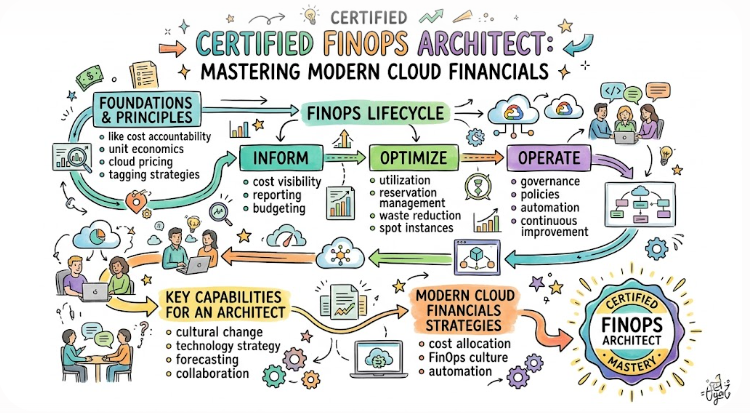
In the rapidly evolving landscape of cloud infrastructure, managing expenditure has transitioned from a back-office accounting task to a core engineering competency. The Certified FinOps Architect program stands as a benchmark for professionals looking to bridge the gap between technical cloud operations and financial accountability. This guide is designed for engineers, SREs, and technical leaders who recognize that cloud efficiency is as critical as uptime or performance. By aligning yourself with the methodologies established by Finopsschool, you gain the framework necessary to treat cloud costs as a first-class citizen in your architectural decisions. This roadmap helps you navigate the complexities of cloud-native financial management, ensuring your career remains resilient in an era of distributed computing.
What is the Certified FinOps Architect?
The Certified FinOps Architect is a professional-grade designation focused on the operational and financial governance of cloud environments. It exists to provide a structured approach to managing the variable spend of cloud platforms, moving beyond simple cost-cutting toward value realization. This certification emphasizes real-world, production-focused scenarios where architectural choices directly impact monthly recurring cloud bills. Unlike theoretical certifications, it challenges you to design systems that are cost-aware, scalable, and transparent. It aligns with modern DevOps and SRE workflows, ensuring that engineering teams can innovate rapidly while maintaining strict fiscal discipline.
Who Should Pursue Certified FinOps Architect?
This certification is designed for a broad spectrum of technical professionals involved in the cloud lifecycle. DevOps and SREs will find immense value in learning how to automate cost-optimization alongside their performance-tuning tasks. Cloud architects and platform engineers will benefit from the architectural patterns that prioritize efficiency without compromising system reliability. Security professionals gain a deeper understanding of how cost-governance integrates with cloud security postures, particularly in multi-cloud environments. Even engineering managers and technical leads in India and across the globe will find this path essential for mastering resource allocation and communicating cloud value to stakeholders.
Why Certified FinOps Architect is Valuable
The demand for professionals who can interpret cloud bills and optimize architecture is at an all-time high as organizations scale their digital footprints. This certification offers longevity by teaching foundational principles of cloud unit economics that transcend specific cloud provider tools or UI updates. It provides a significant return on investment by positioning you as a bridge between technical operations and executive management. By mastering these competencies, you gain a unique skill set that remains relevant as infrastructure complexity grows. It transforms you from an engineer who just builds systems into one who builds systems that maximize business value.
Certified FinOps Architect Certification Overview
The program is delivered via Certified FinOps Architect and hosted on FinopsSchool. It is structured to be practical, focusing on assessments that mirror real-world cloud cost challenges. The certification validates your ability to implement governance, manage tagging strategies, and architect systems for cost-efficiency. It is designed to be accessible to those with hands-on cloud experience while maintaining high standards for professional practice. By completing this program, you demonstrate ownership over your technical environment and the ability to influence organizational cloud culture.
Certified FinOps Architect Certification Tracks & Levels
The certification follows a progression model that mirrors the professional growth of a cloud practitioner. Foundation levels establish the core vocabulary and basic principles of cost allocation and visibility. Professional levels dive into architectural patterns, automation, and advanced forecasting techniques. Advanced levels are reserved for those designing organization-wide FinOps strategies and complex multi-cloud financial governance models. Each level builds upon the last, ensuring a robust understanding that moves from individual workload optimization to enterprise-wide financial health.
Complete Certified FinOps Architect Certification Table
| Track | Level | Who it’s for | Prerequisites | Skills Covered | Recommended Order |
| Core FinOps | Foundation | Junior Cloud Admins | Basic Cloud Knowledge | Cost Visibility, Tagging | 1 |
| Architecture | Professional | SRE / DevOps | 2+ Years Cloud Exp | Auto-scaling, Rightsizing | 2 |
| Strategy | Advanced | Cloud Architects / Leads | 5+ Years Cloud Exp | Unit Economics, Governance | 3 |
Detailed Guide for Each Certified FinOps Architect Certification
Certified FinOps Architect – Professional
What it is
This certification validates your capability to design and maintain cost-efficient cloud architectures that align with business goals. It covers the intersection of technical performance and fiscal governance.
Who should take it
Cloud engineers, SREs, and Platform engineers who are responsible for the daily operation and optimization of cloud-based applications.
Skills you’ll gain
- Advanced cost-allocation strategies.
- Designing for automated rightsizing.
- Implementing cloud-native governance policies.
- Integrating cost-data into monitoring dashboards.
Real-world projects you should be able to do
- Building a cost-aware CI/CD pipeline.
- Developing an automated resource-shutdown strategy for non-production environments.
- Creating a cross-departmental cost-allocation report.
Preparation plan
- 7–14 days: Deep dive into cloud provider cost-explorer tools and basic tagging governance.
- 30 days: Implement three distinct cost-optimization scripts in your current environment.
- 60 days: Review enterprise case studies and mock architecture designs for cost-efficiency.
Common mistakes
Focusing only on cost-cutting instead of value-delivery; ignoring performance-latency trade-offs; failing to implement automated governance early.
Best next certification after this
- Same-track option: Advanced FinOps Strategist.
- Cross-track option: Certified Cloud Security Professional.
- Leadership option: Cloud Engineering Manager.
Choose Your Learning Path
DevOps Path
This path focuses on integrating cost-awareness into the software development life cycle. You will learn to use infrastructure-as-code to enforce cost-governance from the first line of configuration. It is about shifting left on cost-optimization.
DevSecOps Path
Here, you combine security, operations, and financial management. You will learn how to identify over-provisioned security appliances and optimize data retention for logs while maintaining compliance. Efficiency is the key to secure operations.
SRE Path
This path emphasizes the balance between service level objectives and cost. You will master the art of designing resilient architectures that do not bleed capital during traffic spikes. Reliability and cost-efficiency go hand-in-hand here.
AIOps Path
Focus on optimizing the infrastructure footprint of machine learning and AI workloads. You will learn about GPU utilization, storage tiers for massive datasets, and model training efficiency. Resource management for AI is a specialized, high-value skill.
MLOps Path
This path focuses on the lifecycle of machine learning models from a cost perspective. It covers the economics of model serving, retraining schedules, and data lifecycle management to prevent runaway cloud bills in data-intensive projects.
DataOps Path
Concentrate on the financial impact of data pipelines, storage, and processing. You will learn to manage big data costs by selecting the right storage tiers and optimizing query performance. This is essential for data-heavy enterprises.
FinOps Path
This path is the culmination of all financial engineering skills. It is for those who want to lead the organizational change toward a culture of cloud accountability. It focuses on strategy, unit economics, and executive communication.
Role → Recommended Certified FinOps Architect Certifications
| Role | Recommended Certifications |
| DevOps Engineer | Professional FinOps Architect |
| SRE | Professional FinOps Architect |
| Platform Engineer | Professional FinOps Architect |
| Cloud Engineer | Foundation & Professional |
| Security Engineer | Professional FinOps Architect |
| Data Engineer | DataOps & FinOps Architect |
| FinOps Practitioner | All Levels |
| Engineering Manager | Advanced FinOps Strategist |
Next Certifications to Take After Certified FinOps Architect
Same Track Progression
Once you have mastered the professional level, move into the Advanced Strategist tiers. These focus on organizational change management, cross-functional team dynamics, and complex multi-cloud financial orchestration for global scale.
Cross-Track Expansion
Expand your expertise by adding certifications in Security, Data, or AI/ML domains. Understanding how these domains consume budget helps you provide better financial guidance across the entire enterprise stack.
Leadership & Management Track
Transitioning to leadership requires a shift from technical execution to organizational strategy. Pursue certifications related to IT management and cloud governance to better align with the boardroom’s financial requirements.
Training & Certification Support Providers for Certified FinOps Architect
DevOpsSchool
Offers structured training programs with hands-on labs and expert-led sessions designed to help you prepare for and pass the certification with practical knowledge.
Cotocus
Provides specialized cloud training and deep-dive technical workshops focusing on real-world engineering scenarios to help you master architecture and operational excellence.
Scmgalaxy
Delivers comprehensive learning paths for modern infrastructure engineers, emphasizing tools and methodologies that ensure consistent and scalable cloud operations across the enterprise.
BestDevOps
Focuses on the cultural and technical shifts required for successful cloud adoption, providing training that bridges the gap between development and financial operations.
devsecopsschool
Provides rigorous training on integrating security into the CI/CD pipeline, with a strong focus on cost-efficient and secure cloud-native architecture for high-stakes environments.
sreschool
Centers its curriculum on reliability and site engineering excellence, teaching you how to build and maintain high-performance, cost-optimized systems at scale.
aiopsschool
Covers the specialized intersection of artificial intelligence and operations, focusing on efficient resource management for AI workloads and automated monitoring.
dataopsschool
Delivers focused training on managing data lifecycles, pipelines, and the underlying infrastructure costs, ensuring data-heavy applications remain within budget.
finopsschool
The premier provider for specialized FinOps training, offering expert-led guidance and certification pathways that establish industry standards for financial accountability.
Frequently Asked Questions
- How difficult is the certification exam compared to general cloud exams?
The exam is practically oriented and requires a deeper understanding of architectural trade-offs, making it more challenging than entry-level cloud quizzes. - What is the typical time commitment required for preparation?
Professionals generally dedicate between 40 to 80 hours of study and lab practice to gain the necessary competence for the certification level. - Are there any specific technical prerequisites before I begin?
A foundational understanding of cloud platforms like AWS, Azure, or GCP and basic operational experience is essential to grasp the architectural concepts. - Does this certification help with career advancement in the Indian market?
Yes, as Indian enterprises shift to cloud-native models, professionals who can prove cost-governance skills are seeing significant career growth and salary appreciation. - Is there a requirement for recertification?
Yes, given the rapid changes in cloud technology, recertification ensures that your skills remain updated with the latest tools and best practices. - Can I use my current cloud environment for the practical labs?
It is highly recommended to use a sandbox or development environment to experiment with cost-optimization techniques safely without impacting production. - How does this certification differ from general management certifications?
This is a technical, engineering-first certification, focusing on how to implement technical changes that result in financial improvements. - What kind of ROI can I expect after achieving this certification?
You will be able to influence major architecture decisions, potentially saving organizations significant capital, which makes you a high-value asset. - Is the knowledge vendor-specific?
While the principles are applicable across clouds, the practical aspects focus on common architectural patterns that work on all major providers. - Can junior engineers succeed in this certification program?
While it is more suited for those with some experience, a dedicated junior engineer with a strong grasp of cloud basics can absolutely succeed. - How does this certification impact my daily SRE or DevOps work?
It changes your design lens, forcing you to consider cost impact alongside availability and performance during every sprint. - Are there enough resources to prepare for the advanced level?
The program provides comprehensive guides, case studies, and lab environments specifically curated to help you bridge the gap to advanced levels.
FAQs on Certified FinOps Architect
- How do I start applying FinOps?
Start by implementing tagging on all resources and using cost-monitoring tools to gain immediate visibility into your current cloud spend. - Is FinOps only for finance teams?
No, it is primarily an engineering responsibility; finance only provides the constraints, while engineers must design for efficiency. - Does rightsizing affect performance?
When done correctly, it optimizes performance by matching resources to workload demands, rather than just reducing capacity. - What is the first step in cost governance?
Establish clear tagging policies and ensure every resource is accounted for before attempting any complex optimization strategies. - How does architecture influence cloud bills?
Choice of service, data storage tier, and inter-service communication patterns have a massive impact on the final monthly cloud bill. - Can I automate cost-saving?
Absolutely, through infrastructure-as-code and automated policies that trigger based on resource utilization metrics and usage trends. - What is the biggest mistake in cloud cost management?
The biggest mistake is ignoring the cost of data transfer and underutilized resources during the initial architecture phase. - Is this certification globally recognized?
Yes, it is recognized by technical leads and recruiters worldwide as a testament to your ability to manage complex cloud ecosystems.
Final Thoughts: Is Certified FinOps Architect Worth It?
If you want to move beyond being a typical engineer and become someone who understands the business impact of your technical decisions, this is worth it. Do not approach this as a mere checkbox on your resume. Approach it as a way to sharpen your technical judgment. In an era where cloud bills can spiral, being the professional who can confidently optimize an environment for both performance and cost is a rare and highly sought-after skill. The certification provides the structure, but your willingness to apply these principles to real-world production systems is what will truly elevate your career.