Introduction
The modern data landscape is shifting from traditional pipeline management to highly scalable, automated, and resilient data platforms. The CDOM – Certified DataOps Manager designation represents a critical milestone for professionals looking to bridge the gap between data engineering, operations, and enterprise management. This comprehensive guide is written specifically for software engineers, site reliability engineers, cloud architects, and technology leaders who want to understand how this certification fits into their long-term career strategy. By focusing on operational excellence and continuous delivery within data environments, this blueprint helps professionals make informed decisions about their technical training and leadership trajectories. You can find detailed program insights and explore enrollment options via the DataOpsSchool platform, which serves as the primary hub for this specialized curriculum.
What is the CDOM – Certified DataOps Manager?
The CDOM – Certified DataOps Manager is an elite professional credential designed to validate an individual’s capability to design, orchestrate, and optimize enterprise data pipelines using modern operational philosophies. Unlike theoretical frameworks that focus solely on abstract data governance, this certification emphasizes production-focused engineering, automated testing, and continuous integration for data assets. It exists to address the growing friction between data science teams, engineering departments, and business stakeholders by standardizing operational practices. Organizations globally adopt this framework to minimize data downtime, ensure compliance, and build resilient infrastructure that supports real-time decision-making. Achieving this certification demonstrates that a professional can manage complex data lifecycles while maintaining strict system reliability and performance metrics.
Who Should Pursue CDOM – Certified DataOps Manager?
This certification is purpose-built for a wide array of technical professionals aiming to specialize in data-driven operations and infrastructure management. Systems engineers, platform architects, and cloud specialists will find immense value in learning how to apply traditional automation workflows to data pipelines. Experienced data engineers, database administrators, and business intelligence architects can use this credential to transition into strategic engineering management roles. It is highly relevant for both the Indian tech ecosystem, where data operations are scaling rapidly across global capability centers, and the international market, where enterprise data maturity is a core competitive advantage. Even engineering directors and technical project managers benefit from this program, as it provides them with the vocabulary and architectural frameworks needed to oversee modern data teams.
Why CDOM – Certified DataOps Manager is Valuable in Modern Enterprise
As enterprise data architectures grow more complex with multi-cloud deployments and real-time streaming, the demand for structured operational oversight has reached an all-time high. The CDOM – Certified DataOps Manager curriculum provides professionals with a sustainable framework that remains valuable regardless of specific underlying software or cloud vendor tools. By focusing on core operational principles like data observability, immutable pipelines, and automated quality testing, it prevents skills obsolescence in a fast-changing market. The return on time and financial investment is realized through improved deployment velocities, reduced production errors, and a clear path toward technical leadership. Enterprises actively seek certified managers who can align engineering outputs with business objectives while drastically lowering data infrastructure costs.
CDOM – Certified DataOps Manager Certification Overview
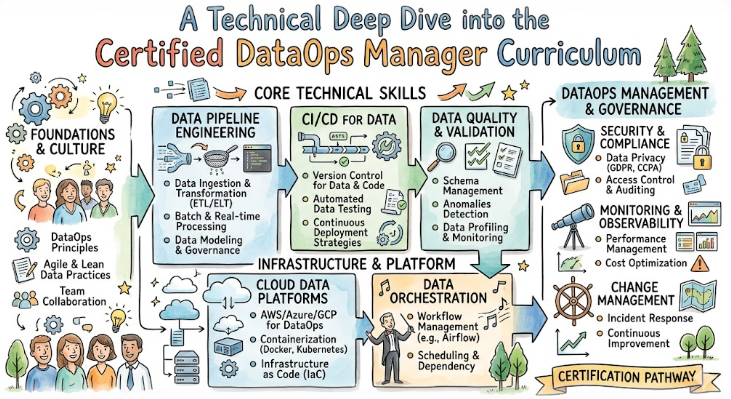
The certification program is delivered through structured modules available at the CDOM – Certified DataOps Manager and is hosted formally on the DataOpsSchool infrastructure. The assessment methodology is rigorously designed to test both conceptual architecture and practical problem-solving capabilities through scenario-based evaluations. Ownership of the certification standard rests with industry practitioners who continuously update the curriculum to reflect actual enterprise operational challenges. The structure spans multiple domains, including automated environment provisioning, version control for data schemas, and comprehensive monitoring strategies. Candidates are required to demonstrate a deep understanding of how statistical process control applies to data flows to ensure consistent delivery quality.
CDOM – Certified DataOps Manager Certification Tracks & Levels
The certification framework is broken down into structured progression tiers to accommodate professionals at varying stages of their career journeys. The foundation level establishes core competencies in automation, data quality metrics, and collaboration philosophies between siloed technical teams. The professional tier dives deep into advanced pipeline orchestration, infrastructure as code for data platforms, and complex monitoring systems. Finally, the advanced level focuses heavily on strategic management, financial optimization, compliance architecture, and scaling organizational capabilities. These distinct levels are mapped directly against industry career paths, allowing engineers to transition seamlessly from individual contributors to enterprise leaders.
Complete CDOM – Certified DataOps Manager Certification Table
| Track | Level | Who it’s for | Prerequisites | Skills Covered | Recommended Order |
| Core Operations | Foundation | Junior Engineers, System Analysts | Basic Data Knowledge | Version Control, Pipeline Concepts, Collaboration | First |
| Advanced Engineering | Professional | Senior Data Engineers, SREs | 2+ Years Data Experience | Orchestration, Automation, Data Observability | Second |
| Enterprise Strategy | Advanced | Engineering Managers, Architects | Professional Certification | Financial Ops, Team Scaling, Governance | Third |
Detailed Guide for Each CDOM – Certified DataOps Manager Certification
CDOM – Certified DataOps Manager – Foundation Level
What it is
This certification validates a foundational understanding of data operations principles, focusing on basic automation, collaboration frameworks, and regular pipeline mechanics.
Who should take it
It is designed for entry-level data analysts, junior systems engineers, and project managers who need to speak the language of modern data operations.
Skills you’ll gain
- Understanding of continuous integration concepts for data pipelines.
- Familiarity with data quality metrics and automated testing basics.
- Knowledge of collaborative workflows between development and operations teams.
Real-world projects you should be able to do
- Configure a basic automated data validation script within a localized repository.
- Map out a simple data pipeline lifecycle from ingestion to final consumption.
Preparation plan
- 7–14 days: Review all fundamental core modules and memorize key architectural definitions and standard metrics.
- 30 days: Work through practice exam scenarios and build basic mock integration workflows on localized machines.
- 60 days: Engage with peer study groups and analyze real-world case studies detailing common failure points in early-stage pipelines.
Common mistakes
- Overlooking the cultural and collaborative aspects of operations in favor of purely technical tooling details.
- Neglecting the fundamentals of version control for schemas and operational configurations.
Best next certification after this
- Same-track option: CDOM – Certified DataOps Manager Professional Level
- Cross-track option: Cloud Infrastructure Foundation Certificate
- Leadership option: Technical Team Lead Associate Certificate
CDOM – Certified DataOps Manager – Professional Level
What it is
This certification validates an engineer’s ability to build, automate, and maintain production-grade, highly resilient enterprise data infrastructure.
Who should take it
Ideal for senior data engineers, site reliability engineers, and platform specialist professionals with several years of hands-on technical experience.
Skills you’ll gain
- Mastery of complex workflow orchestration across multi-cloud environments.
- Implementation of advanced data observability and real-time alerting systems.
- Designing immutable data architecture and schema migration strategies.
Real-world projects you should be able to do
- Deploy a fully automated, self-healing data pipeline that detects and quarantines corrupted records automatically.
- Implement a comprehensive infrastructure-as-code solution for a distributed cluster configuration.
Preparation plan
- 7–14 days: Study advanced orchestration logic, containerization strategies, and deep architectural failure modes.
- 30 days: Build complex, multi-tiered pipeline simulations that incorporate intentional failure points to test your recovery logic.
- 60 days: Deep dive into performance tuning, cost-optimization strategies, and end-to-end security compliance frameworks.
Common mistakes
- Failing to design for scale, leading to pipelines that operate correctly in testing but fail under production volumes.
- Underestimating the complexity of orchestrating stateful data operations across distinct geographic regions.
Best next certification after this
- Same-track option: CDOM – Certified DataOps Manager Advanced Level
- Cross-track option: Site Reliability Engineering Professional Certificate
- Leadership option: Data Engineering Director Leadership Track
CDOM – Certified DataOps Manager – Advanced Level
What it is
This certification validates enterprise leadership capability, strategic architecture planning, governance design, and comprehensive operational management of data organizations.
Who should take it
Principal architects, enterprise engineering directors, and senior technical managers tasked with scaling cross-functional data organizations.
Skills you’ll gain
- Strategic budgeting and financial engineering for multi-tenant data platforms.
- Designing global regulatory compliance and data governance architectures.
- Scaling engineering organizations using modern operational capability frameworks.
Real-world projects you should be able to do
- Design an enterprise-wide data operations strategy reducing operational overhead across multiple business units.
- Architect a global compliance engine that automatically enforces data privacy laws across distributed networks.
Preparation plan
- 7–14 days: Review global compliance mandates, data privacy frameworks, and strategic financial management principles.
- 30 days: Case study analysis focused on large-scale enterprise transformations, organizational design, and risk mitigation strategies.
- 60 days: Synthesize operational metrics across multiple departments to construct a comprehensive organizational performance scorecard.
Common mistakes
- Focusing too much on granular code execution rather than systemic organizational velocity and long-term financial impacts.
- Ignoring the complex human change management required to implement operations at scale across legacy enterprises.
Best next certification after this
- Same-track option: Executive Enterprise Architecture Fellow
- Cross-track option: Advanced Cloud FinOps Fellow
- Leadership option: Chief Technology Officer Strategy Program
Choose Your Learning Path
DevOps Path
Professionals coming from a standard software delivery background should focus heavily on how data statefulness introduces unique challenges to standard CI/CD models. Your path begins by translating code compilation automation into data schema migration automation without causing downstream application breaking changes. You will master the deployment of containerized processing engines and learn how to manage infrastructure as code for highly dynamic workloads. The ultimate goal is to treat data pipelines with the exact same rigor, test automation, and deployment velocity applied to traditional software microservices.
DevSecOps Path
Security-focused practitioners entering this domain must prioritize data security at rest, in transit, and during compute cycles within the pipeline. This learning path centers on integrating automated security scanning, encryption management, and access controls directly into the continuous integration flow. You will learn to architect zero-trust data environments where access permissions are dynamically managed based on the sensitivity of the processing workload. The focus rests on preventing data leaks, maintaining strict audit trails, and ensuring compliance without slowing down pipeline delivery speeds.
SRE Path
Site reliability engineers focusing on data platforms will concentrate almost entirely on system availability, data latency, and error budget management. This path emphasizes data observability, advanced alerting thresholds, and the application of statistical process control to detect anomalous processing behaviors. You will develop automated remediation workflows that isolate failing infrastructure nodes or corrupted data sources before they impact downstream consumer applications. The core objective is maintaining the absolute reliability of the platform while managing the inherent unpredictability of incoming data streams.
AIOps Path
Engineers specializing in AI infrastructure operations focus heavily on building automated monitoring engines that analyze massive telemetry streams to predict system failures. This path covers the practical deployment of machine learning algorithms to automate root cause analysis, optimize resource allocation, and detect anomalies in enterprise environments. You will learn to manage the pipelines that collect log files, trace data, and metrics from complex distributed systems to drive autonomous operational decisions. The final milestone involves designing closed-loop remediation systems that fix infrastructure issues without requiring direct human intervention.
MLOps Path
Machine learning operations professionals focus specifically on the unique lifecycles of statistical models, training datasets, and production deployment environments. This path bridges the gap between raw data preparation pipelines and the continuous deployment of model artifacts into production environments. You will master version control for massive training datasets, automated validation for feature stores, and tracking model performance drift over time. The objective is to establish a seamless pipeline where models are retrained, verified, and safely deployed with the absolute minimum amount of manual intervention.
DataOps Path
Pure data operations specialists focus intensely on the holistic management of data value streams across the entire corporate lifecycle. This path dives deep into optimizing delivery velocity, maximizing data quality metrics, and fostering collaboration among engineers, analysts, and business teams. You will master advanced orchestration frameworks, automated metadata management strategies, and systemic bottleneck analysis techniques across complex enterprise environments. The path prepares you to build comprehensive, self-service data platforms that empower non-technical business units safely and efficiently.
FinOps Path
Financial operations practitioners working within data platforms focus primarily on cost transparency, cloud resource utilization efficiency, and budget predictability. This path guides you through the complexities of analyzing multi-tenant compute costs, storage tier optimizations, and data transfer fee reduction strategies. You will learn to design automated tagging systems that attribute resource consumption costs directly to specific pipelines, business units, or development teams. The goal is to maximize the business value derived from every dollar spent on underlying data infrastructure.
Role → Recommended CDOM – Certified DataOps Manager Certifications
| Role | Recommended Certifications |
| DevOps Engineer | Core Operations Foundation, Advanced Engineering Professional |
| SRE | Advanced Engineering Professional |
| Platform Engineer | Advanced Engineering Professional, Enterprise Strategy Advanced |
| Cloud Engineer | Core Operations Foundation, Advanced Engineering Professional |
| Security Engineer | Advanced Engineering Professional, Specialized DevSecOps Modules |
| Data Engineer | Core Operations Foundation, Advanced Engineering Professional |
| FinOps Practitioner | Advanced Engineering Professional, Specialized Cost Optimization Modules |
| Engineering Manager | Enterprise Strategy Advanced |
Next Certifications to Take After CDOM – Certified DataOps Manager
Same Track Progression
Once you master the management framework, the most logical next step is pursuing deep-tier specializations in advanced distributed compute architectures or massive scale database clustering. This entails diving into specialized certifications that validate your capability to handle petabyte-scale real-time processing networks with zero data loss tolerance. Focusing deeper within the same track establishes you as the definitive technical authority for data platform infrastructure decisions across your entire corporate enterprise.
Cross-Track Expansion
Professionals looking to broaden their market value should consider expanding into adjacent disciplines like cloud platform engineering, site reliability management, or specialized security paths. Gaining certifications in these complementary domains ensures you can seamlessly blend data operations with wider enterprise infrastructure initiatives. This cross-pollination of skills makes you uniquely valuable to organizations building unified engineering platforms that support diverse application and data workloads.
Leadership & Management Track
For those looking to transition fully away from day-to-day configuration and move toward high-level corporate strategy, executive leadership paths are ideal. These certifications focus primarily on change management frameworks, global technology budget allocations, enterprise risk mitigation, and long-term organizational design. Moving along this path positions you perfectly for senior executive roles such as Director of Platform Engineering, Chief Data Officer, or Chief Technology Officer.
Training & Certification Support Providers for CDOM – Certified DataOps Manager
DevOpsSchool provides a comprehensive collection of learning materials, live instructor-led masterclasses, and hands-on laboratory environments specifically built to help professionals clear operational certifications. Their structured bootcamps focus heavily on real-world engineering environments, helping candidates master tool integration, continuous delivery pipelines, and infrastructure management strategies efficiently.
Cotocus specializes in delivering high-impact corporate training and technical upskilling programs tailored for enterprise engineering departments looking to modernize their infrastructure workflows. Their practical lab scenarios mirror complex production challenges, giving engineers the hands-on practice required to successfully pass advanced architecture evaluations.
Scmgalaxy offers an extensive community-driven platform filled with deep-dive tutorials, configuration blueprints, and expert-led forums focused on configuration management and automation. It serves as an excellent reference knowledge base for candidates looking to troubleshoot complex deployment scripts during their preparation cycles.
BestDevOps focuses on delivering highly curated, self-paced learning journeys designed around core operational philosophies, site reliability engineering, and infrastructure automation. Their exam preparation tracks provide highly realistic practice tests that ensure candidates understand practical deployment scenarios thoroughly.
devsecopsschool centers its entire curriculum on the seamless integration of security protocols, compliance checking, and vulnerability scanning directly into modern delivery pipelines. It is the premier training resource for operations managers who need to ensure their data platforms conform to global security standards.
sreschool provides targeted educational paths focusing almost entirely on systems availability, complex incident response strategies, performance monitoring, and error budget calculations. Their courses help data professionals apply traditional reliability engineering principles directly to unpredictable enterprise data pipelines.
aiopsschool offers specialized training programs designed to teach engineers how to deploy machine learning algorithms for automated system monitoring, log analysis, and anomaly detection. Their coursework bridges the gap between infrastructure metrics and autonomous corporate operations management.
dataopsschool serves as the foundational educational institute dedicated explicitly to data operations methodologies, pipeline orchestration architectures, and data quality automation frameworks. It remains the primary hub for professionals pursuing comprehensive certifications in enterprise data platform management.
finopsschool delivers structured courses focusing on cloud cost optimization, cloud asset tracking, resource allocation strategies, and financial accountability within modern engineering teams. Their curriculum is essential for operations managers who must control infrastructure spending without sacrificing performance.
Frequently Asked Questions (General)
- What is the primary focus of an operations management certification?
The main focus centers on creating structured, automated, and repeatable delivery pipelines while minimizing system downtime and ensuring consistently high output quality across the enterprise. - Are these certifications valuable for traditional software engineers?
Yes, they expand your understanding of infrastructure management, resource allocation, and systems architecture, making you a much more versatile and highly compensated engineering professional. - How long does it typically take to prepare for a professional level exam?
Most candidates with prior engineering experience spend between 30 to 60 days of consistent study and practical laboratory practice to comfortably clear the evaluation. - Do these programs require a deep background in writing code?
While expert-level programming is not strictly mandatory, having a solid grasp of scripting languages, automation logic, and command-line configurations is highly beneficial for success. - What is the core difference between DevOps and DataOps certifications?
DevOps focuses primarily on the lifecycle of stateless code deployments, whereas DataOps explicitly manages the complexities of stateful data pipelines, schema changes, and data quality metrics. - Can an engineering manager benefit from a technical operations credential?
Absolutely, it equips managers with the precise technical vocabulary, architectural understanding, and operational metrics needed to effectively lead high-performing engineering teams. - How long do these technical certifications remain valid in the industry?
Most enterprise credentials remain fully valid for two to three years, after which professionals typically recertify or progress upward to the next level. - Are there any formal prerequisites for attempting the advanced tier exams?
Yes, the advanced levels usually require you to have successfully cleared the lower-tier certifications or prove substantial real-world enterprise engineering experience. - Do these training paths focus on a single cloud vendor toolset?
No, modern professional tracks emphasize cloud-agnostic principles and frameworks that can be applied equally across AWS, Azure, Google Cloud, or on-premises infrastructure. - What kind of career growth can I expect after achieving certification?
Professionals frequently transition into senior architecture, site reliability, platform engineering, or executive technical leadership roles with significantly higher salary potentials. - Are online practice exams reflective of the actual certification test?
Authorized practice exams from official providers are highly reflective of the actual testing format, focusing on scenario-based problem solving rather than simple memorization. - How does data observability differ from standard infrastructure monitoring?
Infrastructure monitoring tracks the health of hardware and servers, while data observability focuses deeply on the correctness, lineage, and structural integrity of the moving data itself.
FAQs on CDOM – Certified DataOps Manager
- What specific industry problem does the CDOM – Certified DataOps Manager certification solve for modern enterprises?
It directly addresses the operational chaos caused by broken data pipelines, silent data corruption, and poor collaboration between data scientists and infrastructure engineers. By establishing clear guidelines for automated testing and schema versioning, it ensures data environments are stable, observable, and capable of deploying updates smoothly without disrupting business operations. - Is the CDOM – Certified DataOps Manager exam purely theoretical or does it test practical coding?
The exam combines conceptual architectural scenarios with highly practical problem-solving questions that simulate production failures. Candidates must demonstrate they know how to configure orchestrators, handle data governance mandates, and design automated validation scripts to handle messy data inputs under realistic enterprise constraints. - How does obtaining the CDOM – Certified DataOps Manager impact my day-to-day engineering workflows?
It shifts your approach from reactive troubleshooting to proactive platform engineering by teaching you to build self-healing pipelines and automated data quality checks. Instead of manually fixing broken database tables at midnight, you will design systems that automatically isolate data errors, saving valuable engineering hours. - Can I skip the foundation tier and take the CDOM – Certified DataOps Manager professional exam directly?
If you have multiple years of direct, verifiable enterprise experience managing distributed data platforms, you can often bypass the foundational tier. However, entering at the foundation level ensures you possess no hidden gaps in core operational terminology and collaborative frameworks before facing tougher practical questions. - What specific tools and orchestration engines are covered within the CDOM – Certified DataOps Manager curriculum framework?
The curriculum is designed to be largely vendor-agnostic, focusing on universal architectural patterns rather than individual software quirks. That said, it teaches you how to apply these concepts across popular open-source workflow orchestrators, version control platforms, container ecosystems, and modern data observability suites. - How does the CDOM – Certified DataOps Manager credential help professionals looking to transition into FinOps or cost management?
It includes specific modules on tracking data storage costs, reducing multi-tenant compute waste, and optimizing network transfer fees across complex distributed pipelines. This knowledge allows engineers to show business leadership exactly how operational efficiencies translate directly into massive corporate infrastructure cost savings. - What is the global market recognition for a CDOM – Certified DataOps Manager certified individual?
Enterprises operating large global capability centers, financial institutions, and major e-commerce platforms actively look for this certification to staff their platform engineering teams. It serves as an objective verification that you can manage data infrastructure at scale while adhering to international operational standards. - How frequently is the CDOM – Certified DataOps Manager curriculum updated by its governing body?
The learning curriculum undergoes regular revisions every year to incorporate newly emerging operational patterns, cloud architectural updates, and changing global compliance mandates. This constant updating ensures your certified skills remain completely relevant to what top-tier engineering organizations are building in production today.
Final Thoughts: Is CDOM – Certified DataOps Manager Worth It?
Investing your time and effort into obtaining the CDOM – Certified DataOps Manager certification is an exceptionally smart career move if you want to stay ahead in the shifting tech landscape. As modern enterprise architectures move away from messy, unmonitored script structures toward highly automated, observable platform engineering, the market needs professionals who understand how to run data systems reliably. This certification avoids passing trends by focusing entirely on timeless engineering principles: automation, data quality metrics, cost control, and seamless collaboration. It offers a clear, structured path to elevate your skills from a day-to-day individual developer to a strategic technical leader capable of running enterprise-scale operations. If your goal is to build highly reliable data systems and open doors to top-tier engineering roles, this certification is absolutely worth pursuing.